British Columbia Specialty License Plate Survey Results! |

Quick Links: |
After an inexplicable silence of 22-months, BCpl8s.ca staff submitted a Freedom of Information (FOI) request to the province in November of 2025 seeking the following:
After another 7-month wait and multiple extension requests by various provincial ministries, the requested records were received at the BCpl8s.ca head office on June 24, 2026, in the form of a 1,068 page .pdf document: FOI Request Number CTZ-2025-52788 As can be seen in the link above, the survey responses are too extensive for the volunteer staff at BCpl8s.ca to properly process. So, in the spirit of the "AI Age" we find ourselves living in, a number of LLMs were recruited to assist us in reviewing, compiling and summarizing the data. Accordingly, please be aware that all the information presented below is a summary prepared by AI (with some slight editing by BCpl8s.ca staff). As we are also well aware of the accuracy challenges associated with using AI, we consider the results presented below to be indicative only and look forward to the day that the province releases the official results! In the interim, enjoy and hopefully new specialty license plates will be introduced soon! |
Overview: The formal public consultation period spanned from December 1, 2023, to January 31, 2024, utilizing the online portal hosted by govTogetherBC. Driven by initial regional media coverage and final-week social media promotion by the Government Digital Experience (GDX) team, the consultation experienced a massive late spike in completions. The engagement closed with a robust dataset consisting of 8,257 completed responses, which yields high statistical validity for guiding upcoming provincial policy decisions. Several limitations should be acknowledged and the most significant limitation is the self-selection bias. Respondents chose to participate and therefore may not perfectly reflect the views of all licensed drivers in British Columbia. In addition, some organizations may have encouraged their members or supporters to participate and this can influence participation patterns, but it also provides useful information regarding the capacity of organizations to mobilize future specialty plate purchasers. A substantial proportion of respondents already owned specialty licence plates and, as a result, the survey may over-represent individuals who are already positively disposed toward specialty plate programs. As with any survey, some questions may have attracted higher response rates than others, potentially influencing the reliability of individual findings. |
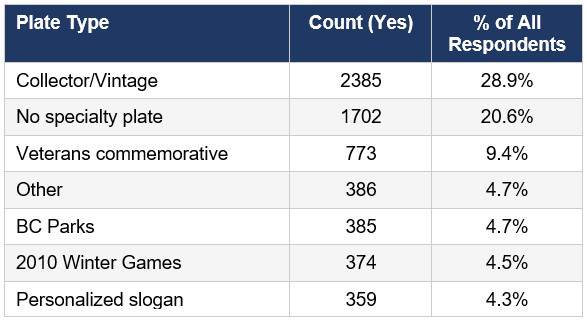
Responses - Question No. 1: Respondents were asked to identify which specialty plates (if any) their household currently has: “Which, if any, personalized or specialty licence plates do you have on vehicles in your household”:
The Key Finding from this question is that the Collector/Vintage category dominates, suggesting the survey captured significant participation from the vintage/collector vehicle community — a segment with existing awareness of specialty plate programs. Note: Percentages do not sum to 100% as respondents could select multiple categories. The 20.6% who selected "No specialty plate" indicates a meaningful share of respondents had no prior exposure to specialty plates, yet still participated in the survey — likely motivated by interest in the proposed program. |
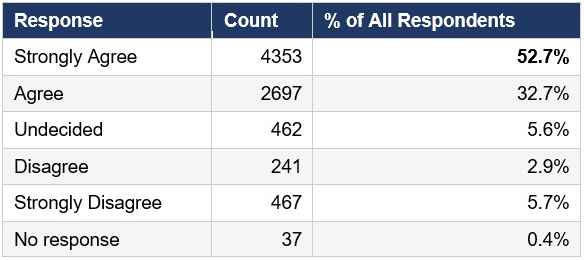
Responses - Question No. 2: Respondents were asked to indicate their agreement with the statement: “I support the introduction of a specialty licence plate program that raises funds for non-profit organizations and charities”:
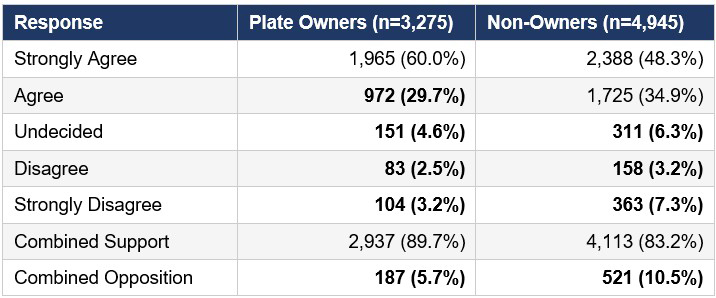
The Key Finding from this question is that combined support (Strongly Agree + Agree) represented 7,050 respondents = 85.4% of all respondents. The combined opposition (Disagree + Strongly Disagree) represented 708 respondents = 8.6%. Undecided: 462 respondents = 5.6%. Only 37 respondents (0.4%) did not answer this question. Respondents who already own at least one specialty license plate showed higher support for the program than those with no specialty license plates. However, both groups show majority support, indicating broad appeal beyond the existing specialty license plate customer base:
Existing Specialty License Plate owners show 89.7% combined support vs. 83.2% for non-owners — a meaningful but not large difference. Both groups show strong majority support. |
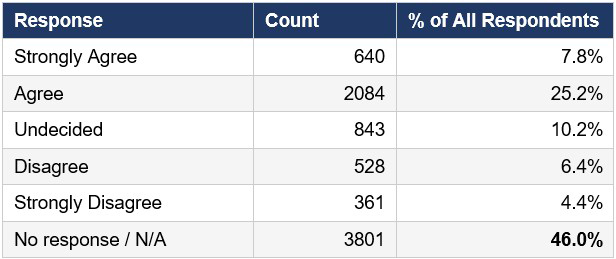
Responses - Question No. 3: Respondents were asked to indicate their agreement with: “I would be willing to pay a one-time fee in addition to the annual renewal fee for a new specialty plate”, which probes the price sensitivity of potential customers:
The Key Finding is that, of the 4,456 respondents who answered Q9: 59.8% agreed or strongly agreed with willingness to pay; 19.5% were undecided; and 20.0% disagreed or strongly disagreed. The high non-response rate (~46%) is likely attributable to survey routing (respondents who answered N/A to all plate ownership questions may have been directed past this question) or respondent drop-off, not necessarily opposition. |
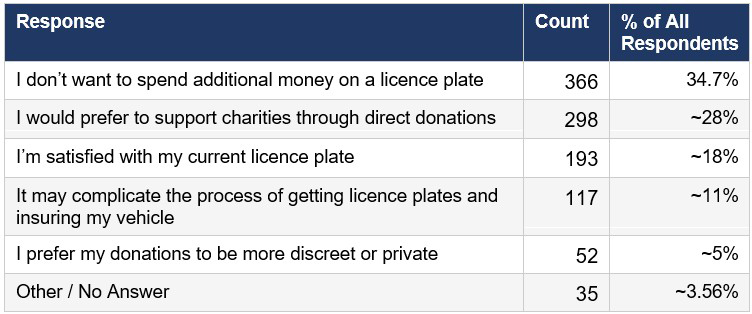
Responses - Question No. 4: Respondents were asked: “What is the primary reason you would not be interested in a specialty license plate?”:
The Key Finding is that cost considerations is the primary motivator for someone considering the purchase of a specialty license plate. However, the secondary finding - that 28% prefer direct charitable donations - suggests that motorists prefer direct donations to their preferred charities, rather than relying on ICBC to do it for them through the purchase of a license plate. |
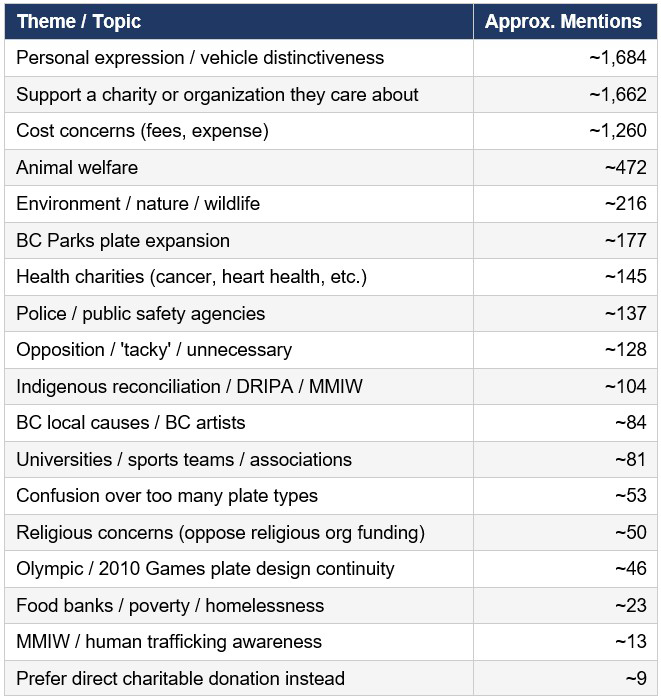
Responses - Question No. 5: The FOI disclosure includes open-ended text responses on approximately 490 pages of respondent comments, which was rendered in a diagonal/wrapped format in a PDF due to the spreadsheet export method, making automated reconstruction difficult. The following theme frequencies were derived from keyword analysis of the raw text extraction and should be treated as indicative rather than precise counts:
The Key Finding is that, of the 4,456 respondents who answered Q9: 59.8% agreed or strongly agreed with willingness to pay; 19.5% were undecided; and 20.0% disagreed or strongly disagreed. The high non-response rate (~46%) is likely attributable to survey routing (respondents who answered N/A to all plate ownership questions may have been directed past this question) or respondent drop-off, not necessarily opposition. Additional themes that came ouf of the open-ended comments are provided below: |
THEME NO. 1: Fee Structure and Opposition to Annual Renewal Fees The most frequently expressed concern across the open-ended comments relates to the fee model for specialty plates. While many respondents are willing to pay an initial one-time purchase fee, there is widespread resistance to ongoing annual renewal fees. This objection appears across supporters and skeptics alike and is the single most consistent thread in the comment data. Respondents generally do not object to paying a premium for a specialty plate at the point of acquisition, but view recurring annual fees as disproportionate and financially burdensome, particularly in the context of already-high insurance costs. Several respondents specifically contrast this model unfavourably with amateur radio or Olympic plates, which carried only a one-time charge. Representative quotes:
|
THEME NO. 2: Charitable Cause Selection and Fairness, Transparency & Scope A second prominent theme concerns how charities and non-profit organizations would be selected to participate in the program, and whether that process would be equitable. Respondents raise concerns about the difficulty of choosing among eligible causes, the risk of appearing to favour certain organizations over others, and the potential for politically or ethically controversial groups to be included. Some respondents call for broad inclusion; others argue the program should be tightly restricted. Sub-themes within this category include:
Representative quotes:
|
THEME NO. 3: Plate Readability & Public Safety A consistent minority of respondents express concern that proliferating specialty plate designs may compromise plate readability for law enforcement, automated licence plate readers, and the general public. These commenters often invoke road safety and the ability to report incidents as reasons why the standard plate format should be preserved or at minimum carefully maintained. Some respondents specifically cite the current BC Parks plate as an example of a design that is already difficult to read, particularly at distance or in low light. Others raise concerns about the ability to distinguish out-of-province plates when BC offers many competing designs internally. Representative quotes:
|
THEME NO. 4: Desire for Sports Team Plates Support for sports team–branded licence plates represents one of the most enthusiastic and clearly defined sub-groups in the comment data. Respondents frequently cite examples from Alberta (Edmonton Oilers, Calgary Flames), Manitoba (Winnipeg Jets), and Washington State as evidence that such plates are popular and financially successful. The Vancouver Canucks and BC Lions are mentioned most often as desired BC equivalents. Some respondents who support sports plates suggest that proceeds should still go to charity (e.g., the Canucks for Kids Fund or BC Children’s Hospital). A smaller number oppose sports plates on the basis that professional sports franchises are commercial enterprises and should not be treated the same as charities. Representative quotes:
|
THEME NO. 5: First Responders, Emergency Services & Military Recognition Many respondents advocate for specialty plates recognizing emergency service workers: firefighters (both career and volunteer), paramedics, search and rescue volunteers, police officers, and members of the Canadian Armed Forces. This category overlaps with the existing Veterans plate but extends further to include currently serving members and civilian emergency responders, groups perceived as not currently recognized. Several respondents note that comparable plates exist in other provinces (Nova Scotia, Alberta) and US states, and express frustration that BC has not introduced similar recognition. Some suggest that emergency responder plates should carry a discounted fee or no fee at all as a form of acknowledgment. Representative quotes:
|
THEME NO. 6: Opposition to the Program Concept A meaningful proportion of the open-ended comments come from respondents who oppose specialty plate expansion at a fundamental level. Their objections range from cost and administrative burden to concerns about equity, ICBC’s appropriate mandate, and the broader implications of allowing licence plates to carry organizational messaging. Common arguments in this category include:
Representative quotes:
|
THEME NO. 7: Environmental, Conservation & Indigenous Causes Respondents who are enthusiastic about expanded specialty plates often identify environmental conservation, wildlife habitat, and Indigenous reconciliation as the most appropriate cause categories for such a program. There is strong support for plates benefiting the BC Wildlife Federation, Backcountry Hunters and Anglers, freshwater fisheries, conservation land trusts, and outdoor recreation organizations. A distinct sub-group advocates for a plate supporting Indigenous reconciliation, noting the significance of DRIPA and the broader reconciliation context in BC. Representative quotes:
|
THEME NO. 8: Plate Design Quality & Expansion of the BC Parks Program Many respondents who already hold BC Parks plates express pride in the program and want to see it expanded rather than diluted. Common requests include more image choices representing northern and interior regions of the province, motorcycle eligibility (currently restricted), and personalization options combined with the specialty background. Some respondents criticize the current Parks plate design as aesthetically poor or difficult to read, and call for a redesign. Representative quotes:
|
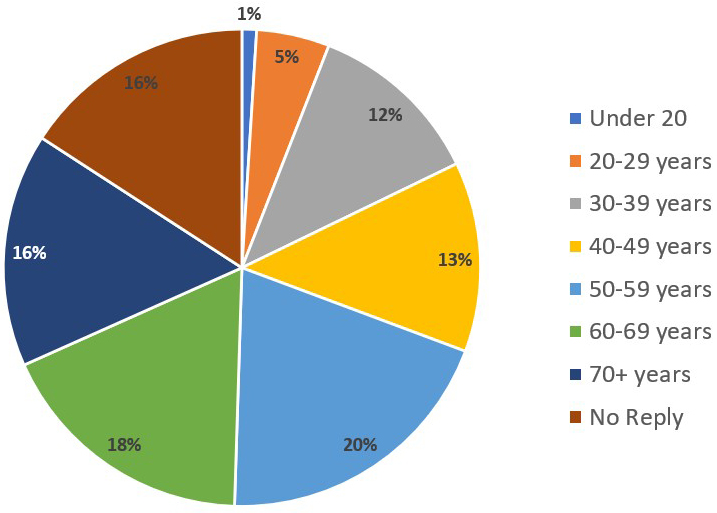
Demographics: The survey captured voluntary demographic markers across three primary metrics: driving/insurance status, age distribution, and gender identity. On the first metric, Age Distribution, respondents indicated the following:
Key Findings: the respondent curve skews heavily toward mature and senior demographics with drivers aged 50 and over make up a combined 54% of the explicit response pool, while young drivers under the age of 30 represent only 6% of total participation. 16% of respondents preferred not to answer . The high participation rate among older demographics highlights a notable engagement gap among younger B.C. drivers. Because older demographics traditionally possess higher disposable income, their support validates the short-term financial viability of an new Specialty Licence Plate program. |
On the second metric, Driving and Insurance Status, an absolute majority of 95% of respondents identify as holding a valid B.C. driver’s licence and a matching auto insurance policy under their direct name . Approximately 4% possess a valid licence but do not hold an active vehicle policy under their name, and 1% occupy non-licensed or non-insured positions . The response base is almost entirely made up of active, paying consumers within the ICBC system. The survey feedback reflects the opinions of the actual customer base who will handle registration and renewals, giving these fiscal insights serious weight. |
On the final metric, Gender, respondents identified as:
The disproportionate representation of male-identifying respondents suggests an automated self-selection bias toward automotive-related policy topics. Program designers should adjust for this skew when evaluating design options, ensuring that final plate concepts appeal across all demographics rather than catering solely to traditional automotive interests. |
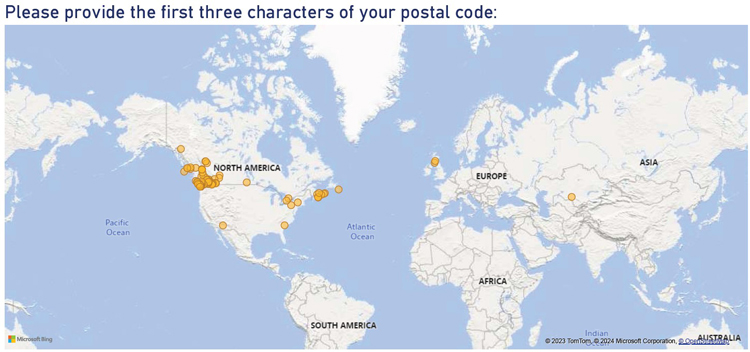
Where in the World is ... One of the options available to respondents was to advise the province where in the World they were located when completing the survey. The vast majority of people resided in British Columbia, but the "Long Distance Award" goes to someone in ... Kazakhstan?!?
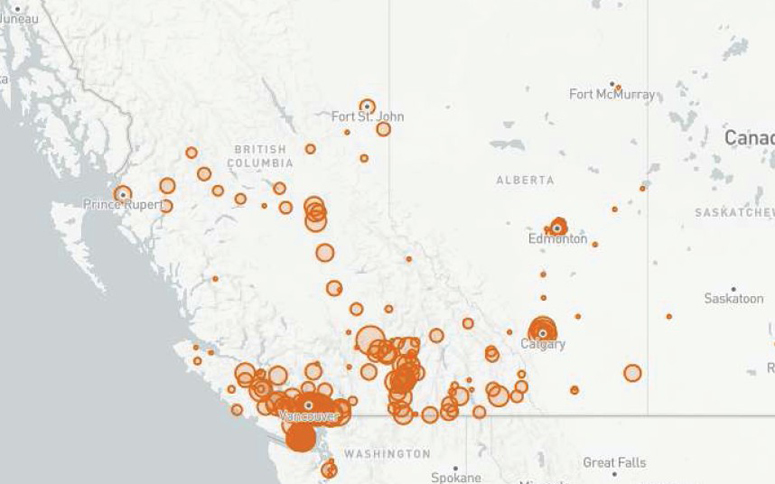
A more detailed "Heat Map" that focused most on British Columbia was produced the week of January 23, 2024, and shows where responses within BC and neighbouring jurisdictions (e.g. Washington and Alberta) were originating:
|
Participation ... Another interesting tidbit contained in the FOI materials, is the response rate by day, starting on the opening day of the Survey (December 11, 2023) through to January 23, 2024 (NOTE: the survey was open until January 31, 2024). Following an initial surge of interest, responses dropped off with the exception of an artificial bump on January 17th when the Government Digital Experience (GDX) Division sent out a "push" on social media to encourage more participation:
|
.jpg)
Floatsam and Jetsam - Year of Manufacture Plates An interesting aspect of the survey are the items that people volunteered that the province had not really asked for input on, such as "Year of Manufacture" (YOM) plates. A distinct and well-organized sub-group of respondents specifically requested the ability to register year-of-manufacture licence plates on collector or vintage vehicles. This is a long-standing request from the classic car community in BC, with many respondents noting that other jurisdictions permit this and that BC’s existing collector plate regime does not accommodate it. For those unfamiliar with the concept of YOM plates, it is an original licence plate that was actually issued in the same year as a vintage vehicle and is later authorized for use on that vehicle instead of a modern plate. So, for example, if you own a 1967 car, a YOM program may allow you to register and display an authentic 1967 BC licence plate, provided it meets certain requirements (such as being in good condition, having a number that isn't already registered, and matching the correct year). Respondents in this group often make explicit reference to organizations such as the Vintage Car Club of Canada (VCCC), the BC Hot Rod Association (BCHRA), and the NAACC, and frame the ask as both a heritage preservation measure and a potential revenue generator for ICBC. Some representative quotes from this group included:
|
Floatsam and Jetsam - Eliminate Front Plates Of course these hosers would use this opportunity to advocate for something that the province has indicated multiple times over the past 30+ years they have no intention of doing; eliminating front license plates. If you are asking yourself what this has to do with specialty licenses; nothing! These guys - and they are always invariable guys - can't help themselves and think they are on the right side of this issue, even though major studies have indicated the strong policy rationales for maintaining front plates. This comes up so regularly, we felt compelled to create a page dedicated to the issue, to read more about it; Click here! Regardless, the LLMs noted a recurring and unsolicited suggestion from this group ("not directly related to the survey question" Ha!) about the elimination of the mandatory front licence plate. This comment appeared frequently enough across the dataset to constitute its own theme. Respondents noted that Alberta and other provinces do not require front plates, that modern vehicles often lack a front mounting provision, and that removal would reduce material costs and waste (none of which is true!). Some representative quotes from this group included:
|
Quick Links: |

Antique | APEC | BC Parks | Chauffeur Badges | Collector | Commercial Truck | Consul | Dealer | Decals | Driver's Licences | Farm | Ham Radio | Industrial Vehicle | Keytags | Lieutenant Governor | Logging | Manufacturer | Medical Doctor | Memorial Cross | Motive Fuel | Motor Carrier | Motorcycle | Movie Props | Municipal | National Defence | Off-Road Vehicle | Olympics | Passenger | Personalized | Prorated | Prototype | Public Works | Reciprocity | Repairer | Restricted | Sample | Specialty | Special Agreement | Temporary Permits | Trailer | Transporter | Veteran | Miscellaneous |
© Copyright Christopher John Garrish. All rights
reserved.