|
British
Columbia Special Agreement License Plates

A
special thanks to Paul
Keenleyside (ALPCA #5595) for providing most of the
information found on this page,
and Andrew Osborne (ALPCA #3259) for consenting to its reproduction
on these pages.
The authority to issue Special Agreement license plates was originally derived from the Industrial Roads Act, and prior to amendments being implemented in the early 1970s following the election of the New Democratic Party, it is thought the logging companies were required to produce their own identification plates (examples of these may be found under the VIN page - see link above).
Special Agreement
plates are one of the hardest of modern BC plate types to
find, be it on the road
or in the hands of a plate collector. This is because very
few of these plates were ever issued, and when they were
issued it was only to two companies in relatively small,
isolated communities.
There are generally
three prefixes that are associated with the Special Agreement
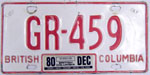
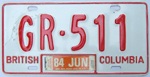
plate type. These are the "GR" prefix that were
issued to Tahsis Forestry Company and truck owner-operators
contracting to the company around the area of Gold River
(a former company town). The second type is the "CL"
prefix which was issued to Cominco in the town of Trail,
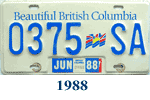
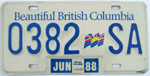
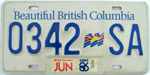
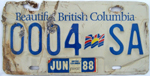
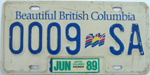
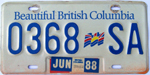
and finally the "SA" prefix which amalgamated
the former two prefixes into a single plate type in 1985-86
when the Flag Graphic series was first issued.
Gold
River is located approximately 60km west of Campbell River
on Vancouver Island, and was originally developed in 1965,
with a pulp and paper mill that opened in 1967 and operated
continually until a down-turn in the forestry sector in
the late 1990s forced its closure in 1999.
|
 |
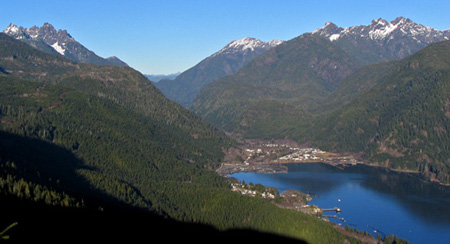 |
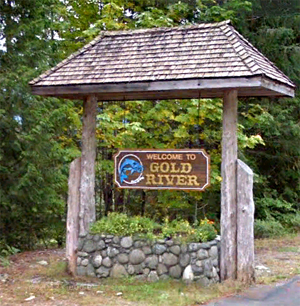
At left, the welcome sign to Gold river. Above, an aerial image of Tahsis with the inlet and forest covered slopes. |
Due to the topography
of the area, when Gold River
was developed there was no room for both an exclusive logging
road and a public highway. So,
the British Columbia Highways Department re-engineered the
logging road with 12-foot lanes as part of Highway 28. Once
the road was finished, plates were issued (not the modern
SA plates), so that the large logging trucks could legally
use the highway when fully loaded.
These trucks could only
otherwise use Highway 28 if they were empty and escorted
by a pilot car. In the 1970s,
there was Company Logging Division (otherwise known as a
"Camp") located west of Gold River. The majority
of the trucks used at this camp were fitted with the GR
series Special Agreement plates, as were some of the private
truck owners contracted to haul lumber to the mill.
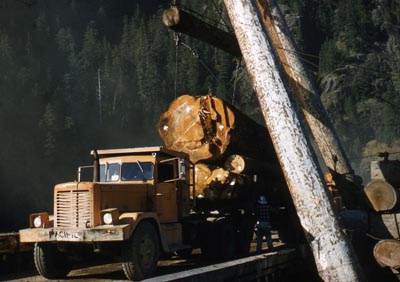
Trucks with these
plates generally tended to weigh anywhere from 120 to 140
tons (or more when pulling a log wagon with trailer). When
fully loaded, the trucks could be from 12-14 feet wide.
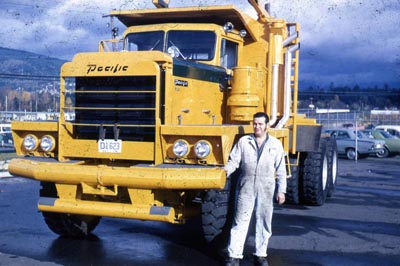
Of the trucks used, all of them were built in the Vancouver
area for West Coast use although there were also Canadian Kenworth and
Pacific.
|
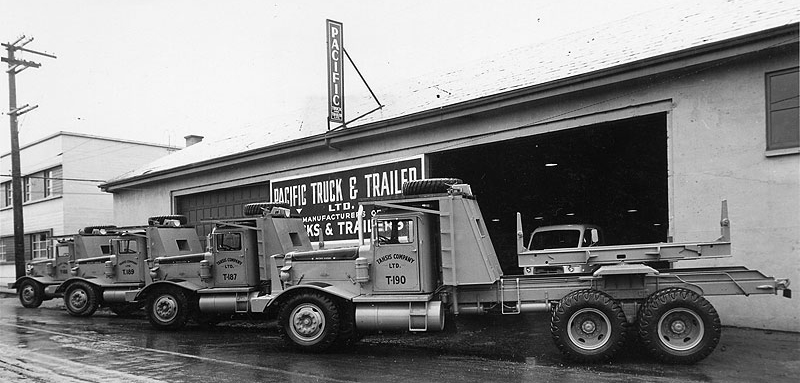
In this photo, courtesy of Bob Dingsdale, are a number of Pacific trucks destined for work in the Gold River and emblazoned with the name of the "Tahsis Company Ltd" on the side of the driver's door. |
|
|
Photos courtesy of Bob Dingsdale
|
|
First known issue
of the GR plates was in 1973, with new plates being issued
each year (with alternating colours) to 1979 when yearly validated
plates in the red-on-white colour scheme (similar to the Dealer
and Repairer plates issued that same year). As mentioned above,
when the Flag Graphic came out in 1985, the plates switched
to the current 1234-SA format. |
| 1973
- 1978 : Gold River |
|
|
|
|
| Issuing
Statistics |
1973:
|
|
1974:
|
|
| 1975:
|
GR-201
to GR-250 |
1976:
|
GR-251 to GR-300 |
1977:
|
GR-301
to GR-350* |
1978:
|
GR-351 to GR-400* |
* Estimate / Un-confirmed |
|
|
|
|
|
|
|
|
|
|
|
|
|
|
|
|
|
|
|
|
|
|
| 1973
- 1978 : Cominco |
|
|
|
|
| Issuing
Statistics |
1973:
|
unknown |
1974:
|
unknown |
1975:
|
CL-551
to CL-575 |
1976:
|
CL-576 to CL-600 |
1977:
|
unknown |
1978:
|
unknown |
|
|
|
|
|
|
|
|
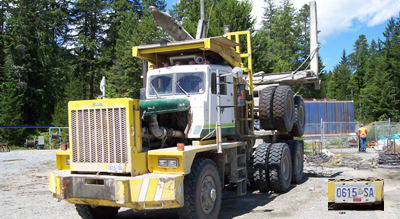 |
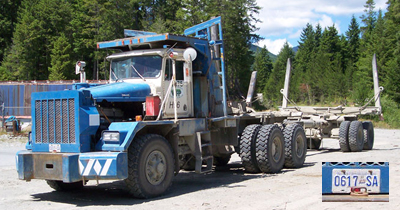
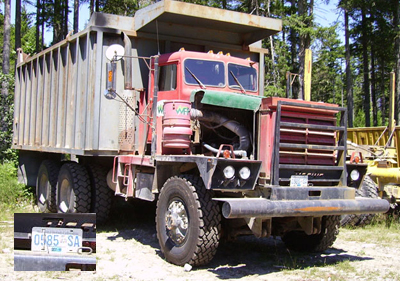
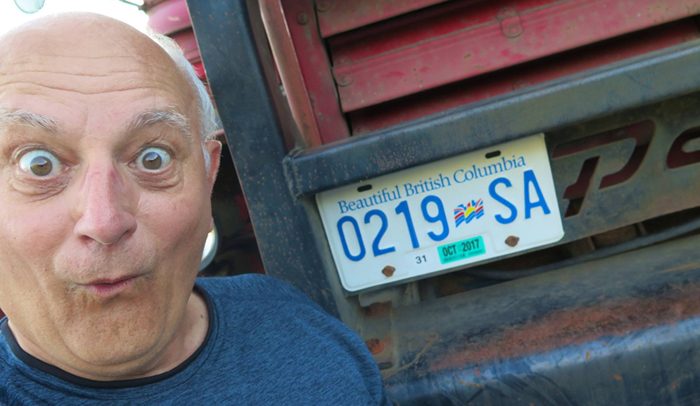
Much to our surprise at BCpl8s.ca, we were alerted in 2009 to the continued existence of the Special Agreement plates at Gold River. Despite the low resolution of the adjoining photos, "SA" suffix plates are clearly visible on the trucks and, as of 2006-07, were into the 0600-SA range. Interestingly, in ICBC's 2013 RFQ for license plates, Special Agreement plates are still part of the contract, are "rarely" ordered with about 50 pairs issued every year through a local Autoplan Agent serving the Gold River area. |
|
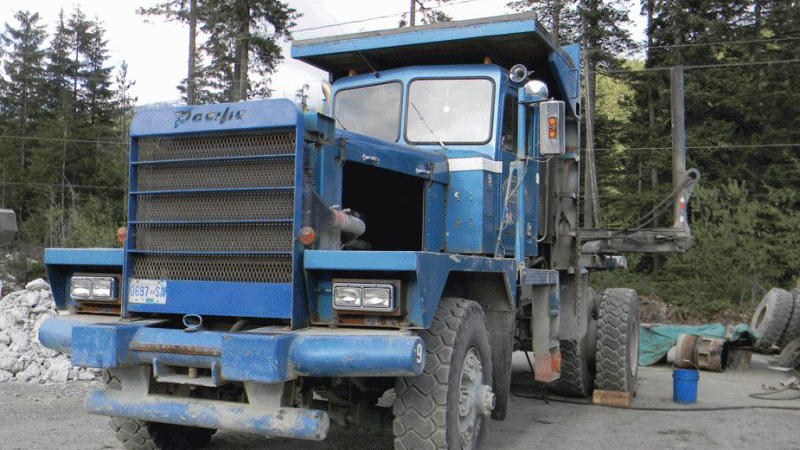
At the time of our decennial check-in at Gold River, the continued use of the Special Agreement plates was confirmed, but with a twist. While the dies are still Astrographic (despite having not made a plate for the province in 15 years) the number block has reverted back to the 200s! We had assumed that they were now into the 700 bloc given another recent photo (showing No. 0697-SA): |
 |

© Copyright Christopher John
Garrish. All rights reserved.
|
.jpg)
.jpg)

.jpg)
.jpg)

.jpg)
.jpg)

.jpg)
.jpg)
.jpg)

.jpg)
.jpg)
.jpg)


.jpg)


.jpg)
.jpg)
.jpg)
.jpg)
.jpg)
.jpg)
.jpg)
.jpg)
.jpg)
.jpg)
.jpg)

.jpg)
.jpg)
.jpg)