|
British Columbia Municipal License Plates

The first provincial law concerning municipalities (i.e. An Act Respecting Municipalities) was passed in 1872, the year after British Columbia entered Confederation, and laid out basic criteria regarding the creation of city municipalities, the election of councils, and municipal taxation. |
A more extensive set of provincial laws - the Municipal Clauses Act - specifying areas of municipal responsibility would not be passed until 1896. Even then, it would not be until amendments to the Municipal Clauses Act in 1906 that municipalities would be granted the power to issue licences, and levy and collect fees for commercial vehicles. |
It is thought that the Vancouver Incorporation Act, had earlier empowered that municipality to regulate and license owners and drivers of stage coaches, livery, feed and sale stables and or horses, drays, express wagons, carts, cabs, carriages, omnibuses, etc ... |
|
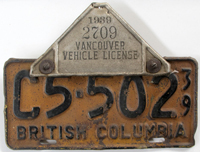
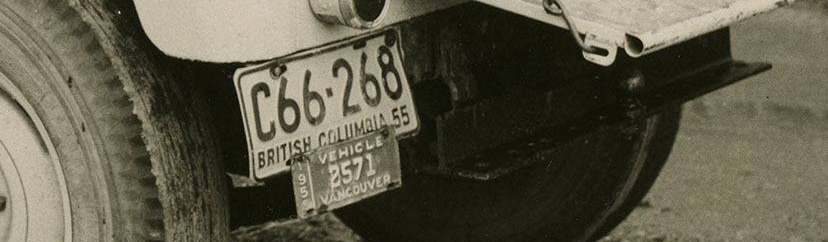
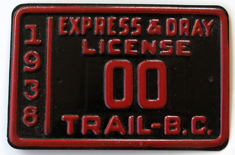
The plate shown at left would have been issued to operators of drays or express wagons within the City of Vancouver. The date at right make the year of issue easy to determine. For those unfamiliar with what might constitute a "dray", it would have been a low heavy horse cart without sides that was used for haulage. It is assumed that a different classification of license would have possibly applied to motor vehicles. |
|
For other municipalities, the amended Act would allow them to collect such fees "from any person owning a pack train of six or more animals, freight wagon, stage coach, or omnibus used in transporting goods for profit or hire ..." |
In the context of automobiles, this would lead many municipalities to require a separate license plate for each community in which a vehicle was engaged in inter-municipal business. |
One of the first such plates came from the City of Victoria and, while it remains unclear as to whether their authority derived from their own Incorporation Act or the Municipal Clauses Act, their early issue porcelain license plates remain one of the more unique and rare of BC plate types: |
It is thought that these porcelain plates were first issued in 1913 following amendments to the City's Bylaw "Regulating Hired and Other Vehicles" that were enacted on July 22, 1912. |
For example, the Bylaw specifies that no person shall "drive or stand or ply for hire with such vehicle unless it is so registered, and unless such vehicle shall have attached to and exposed on the back thereof securely fixed in a conspicuous place a white enamelled plate of a size not less than six by four inches, exhibiting said number in blue or black figure not less than three inches in height and the City Coat of Arms above said number". |
The actual plates that were produced for the City ended up measuring approximately 8" x 5", with black numbers exactly 3" in height with, obviously, the City Coat of Arms above.
|
While it remains unknown exactly how many of these plates are still in existence, we are fairly confident that there are at least eight (on the basis that we have actual photos of these).
|
Interestingly, it is also known that plate No. 89 was found by George Gorse of Victoria in 1950 when he was digging in his backyard and that plate No. 98 (for which we don`t yet have a picture or know of its whereabouts) was dug up in the Gordon Head area of Victoria by Joe Howroyd in the late 1940s
|
Plate No. 1 came to light in the year 2000 and, as the story goes, had been issued to Samuel William Eastman, the owner of a hack business at St. Lawrence Street near the "Outer Wharf" area of Victoria, who also operated a stand on the north side of the Empress Hotel. Altogether, his fleet consisted of five hacks and one sleigh. Interestingly, the grandson of the owner recalled seeing the plate hanging from the family's fireplace from the 1960s when they moved from Victoria to Saanich. |
The similarity of the Victoria plates with the porcelain plates issued by the Provincial government in 1913 is also quite striking and leads one to think that the two levels of government worked together on the introduction of standardised licence plates to their jurisdictions. Prior to 1913, motorists had been required to manufacture their own plates to display their provincial registration number, which lead to wide discrepancies in design and styles. |
|
For example, the two plates shown at left were photographed together shows the City of Victoria issue at top, while the one at bottom is the first provincially issued BC motorcycle license plate from 1913. |
As can be discerned from the photo, the basic materials used are the same (being a porcelain cover on a heavy gage steel base); the sizes are identical; the bolt hole placement and rivets in each corner and slot hole placement along the top all correspond; as does the alignment of the two vertical lines found to the left and right of each plate. |
On closer inspection, it is also possible to match the font used on the numbers as well as the letters: |
|
The typeface used for the letters shows the same outward cut on the ends of the letter 'C' - although the Victoria 'C' has been condensed to allow for additional letters. |
|
*
* * * * |
Allowing a municipality to license a vehicle was intended to
provide a source of revenue to participating municipalities to offset
expenses related to the use of local government roads and highways as a
result of commercial vehicle traffic. Expenses would include the cost of
maintenance of municipal roadways, road signage, snow removal,
parking control, etc ... |
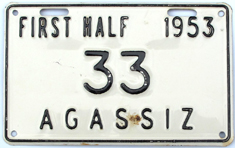
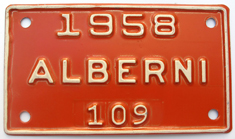
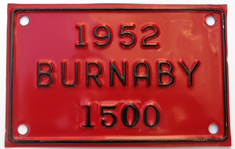
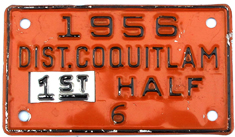
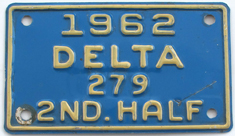
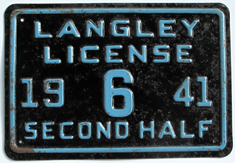
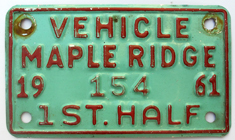
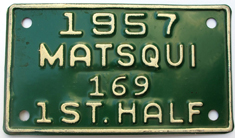
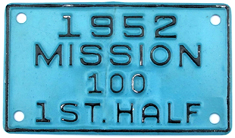
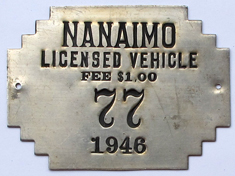
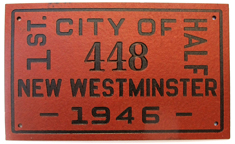
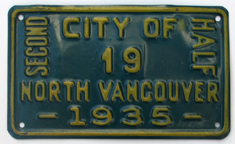
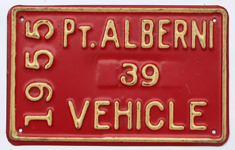
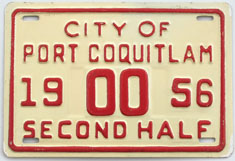
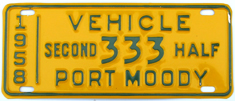
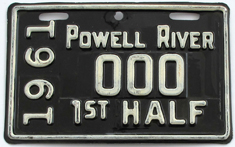
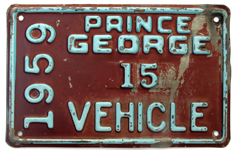
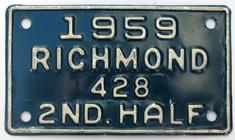
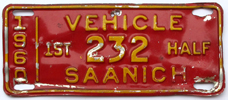
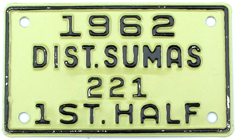
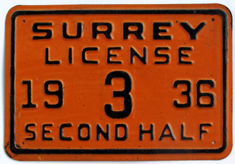
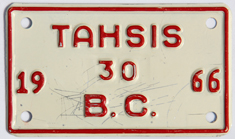
Interestingly, licensing was generally done on a semi-annual basis. Click on any one of the following plates to see a larger gallery of local government issued license plates: |

*
* * * * |
The Village of Tahsis, situated on the west coast of Vancouver Island had originally started as a floating logging camp in the 1940s with the only access being by boat. This later evolved into a permanent on-shore camp, which began to take on the semblance of a village in the 1950s. The road from Tahsis to Gold River was only opened to the public in 1972. Until this time, the community was effectively a company town and all roads were private, so vehicles technically did not need to be registered with the province. Nevertheless, the Tahsis Company did keep track of vehicles operating on its road by issuing its own form of licence plate: |
|
There is also a known variation of this plate which is dated, and is thought to have been renewed the following year through the use of a small brass tab: |
|
*
* * * * |
Throughout 1961-62, a Standing Committee of the BC Legislature on Municipal Matters held hearings in relation to the licensing of commercial vehicles in the province by local government. |
The licensing of commercial vehicles had, by this time, become an important source of income for local governments, however, an earlier report by a Provincial Royal Commission of Inquiry into Road-User Charges in 1960 had already determined these charges to be excessive. Specifically: |
The question whether a municipality should continue to have their present discretion in levies on commercial vehicles, and which they will no doubt exercise if the Province does not place a reasonable ceiling thereon, is a matter of policy. Our inquiry suggests that the level of these individual municipal levies is already excessive for any privilege which they confer. The pyramiding effect of these levies by many municipalities on commercial vehicles engaged in inter-municipal or long haul operations is as effective as a barrier to inter-provincial commercial road transport as municipal embargos or tariff-walls ... which are illegal. Efficient and competitive intra-provincial commercial road transport is seriously endangered by the "jungle" of multiple municipal commercial vehicle levies. |
Municipalities objected to this characterisation and pointed out that the Motor Carrier Act exempted vehicles engaged in the legitimate transport of freight between municipalities. |
By way of example, Surrey was shown to have registered 169 vehicles of local business operations in 1961, and a further 499 vehicles originating from outside its boundaries; while Langley licensed 92 local vehicles and another 424 outside vehicles. The point being that outside businesses were disproportionately using local infrastructure and should be required to pay. |
In considering changes to the current system, the Union of British Columbia Municipalities (UBCM) put forward suggestions from its members, including the provincial collection of fees as this "would eliminate the need for a Municipality operating in this controversial field of licensing" (Victoria); that "one licence good for all areas, as per the P.U.C. Plate" be created (West Vancouver); and that "a metropolitan area collection agency be established under the auspices of the U.B.C.M. or some other municipal agency to issue licences" (Burnaby). |
|
|
* Additional information related to the "Exempt" license plates is presented below * |
Many of the UBCM's suggestions would be incorporated by the Province the following year when it created the single Municipal plate valid throughout British Columbia (as well as the related "Exempt" plate). |
Apart from some minor design differences, one of the more interesting aspects of these plates is that they employed the colour scheme seen on the 1961 passenger plates. |
| 1963
- 1978 |
 |
|
|
|
Issuing
Statistics |
1963:
|
unknown |
1964:
|
unknown |
1965:
|
unknown |
1966:
|
unknown |
1967:
|
unknown |
1968:
|
unknown |
1969:
|
unknown |
1970:
|
unknown |
1971:
|
unknown |
1972:
|
unknown |
1973:
|
unknown |
1974:
|
unknown |
1975:
|
unknown |
1976:
|
unknown |
1977:
|
unknown |
1978:
|
unknown |
|
|
|
|
|
|
|
|
|
|
|
|
|
|
| 1979
- 1982 |
|
|
|
|
Issuing
Statistics |
1979:
|
unknown |
1980:
|
unknown |
1981:
|
unknown |
1982:
|
unknown |
|
|
*
* * * * |
For 1983, a renewable base through the use of registration decals was introduced, and would be used through 1986. |
| 1983
- 1986 |
|
 |
 |
|
Issuing
Statistics |
1983:
|
unknown |
1984:
|
unknown |
1985:
|
unknown |
1986:
|
unknown |
|
|
*
* * * * |
In 1987, the license plates were replaced with a single, province-wide decal. In that same year, the Union of British Columbia Municipalities (UBCM) assumed administration of the Commercial Vehicle Licence Program from the provincial government. |
Participating municipalities receive from UBCM license decals for the license year. The decals are then issued by municipalities to owners of commercial vehicles defined as such and licensed under the Commercial Transport Act and used on a highway within a municipality. |
The single decal is recognised province-wide and replaced the requirement for individual plates from each community, for those vehicles engaged in inter-municipal business. When issuing a decal, the municipality retains an administration fee and any transfer fees. The balance of the fee is remitted to UBCM and deposited into a Commercial Vehicle Licence trust account with proceeds distributed to the participating members on a per capita basis at the end of the licensing year (estimated at $890,000 for the 2008 licensing year). |
A minor design change can be seen in the decals following the introduction of the Local Government Act in 2000 which defined a "licence plate" issued under Division 3 as also including a "licence decal" - hence the changed reference on the decals from "plate" to "decal". |
| 1987
- 2013: Commercial Vehicle Licensing ("Municipal") Decals |
|
|
1989 |
1990 |
Issuing
Statistics |
1987:
|
unknown |
1988:
|
unknown |
1989:
|
unknown |
1990:
|
unknown |
1991:
|
unknown |
1992:
|
unknown |
1993:
|
unknown |
1994:
|
unknown |
1995:
|
unknown |
1996:
|
unknown |
1997:
|
unknown |
1998:
|
unknown |
1999:
|
unknown |
2000:
|
unknown |
2001:
|
unknown |
2002:
|
unknown |
2003:
|
unknown |
2004:
|
unknown |
2005:
|
unknown |
2006:
|
unknown |
2007:
|
unknown |
2008:
|
unknown |
2009:
|
unknown |
2010:
|
unknown |
2011:
|
unknown |
|
|
1991 |
|
 |
 |
 |
 |
|
|
|
|
|
|
|
|
|
|
|
|
|
|
2011 |
2012 |
2013 |
|
 |
 |
These particular municipal decals (shown above) were attached to a British double decker bus operated by Royal Blue Line of Victoria. The bus is now one of about a dozen a kept at a boneyard north of the city (shown at left). |
Despite the introduction of the "Municipal Decals" in 1987, Section 668 of the Local Government Act still requires that a commercial vehicle must not be operated on a highway in a participating municipality unless the vehicle is displaying a valid licence plate (granted, the definition of a "licence plate" now includes a "licence decal"). |
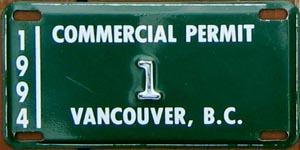
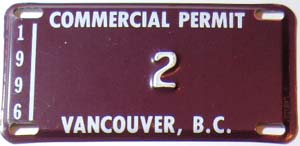
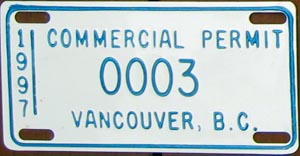
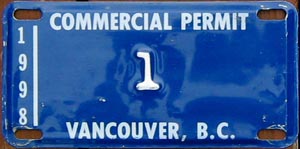
Accordingly, there are still a few examples where an individual municipality will issue its own license plate. The City of Vancouver is probably the best example of this, where, under its Vehicle Licensing By-Law No. 4021, the following applies: |
The vehicle must display a permanently affixed BC Provincial “Municipal Decal” AND have either:
| |
a. |
Permanent business identification with business name and address on both sides of the vehicle. Business identification must be in letters and figures not less than 5 cm. high. |
| |
|
OR |
| |
b. |
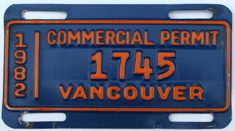
A City of Vancouver “Commercial Permit Plate”. In this case no vehicle signage is required. |
|
|
The promoted benefits of displaying the decal or plate in Vancouver generally relate to loading privileges, such as stopping in a commercial load zone without cost, or being able to use a metered space without charge prior to 10:30am. |
Interestingly, the British Columbia Trucking Association (BCTA) opposes the municipal decal requirements and has advocated for its abolition on the basis that "the benefits once provided to commercial vehicles within a municipality (for example, commercial loading zones) have been greatly reduced or else are virtually non-existent." |
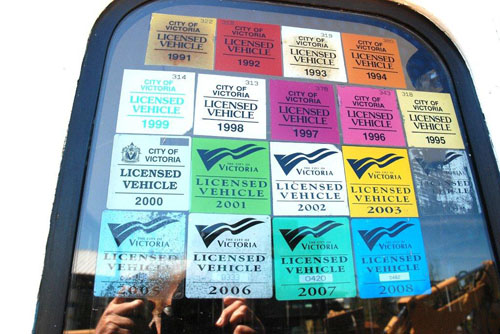
 |
As can been from the image at left, the City of Victoria also retains the ability to licence certain classes of vehicle. These particular decals were attached to a tourist bus operated by the Royal Blue Line. |
*
* * * * |
The Local Government Act and, its forerunner the Municipal Act, have always provided exemptions for certain vehicles from the requirement to display a municipal license plate (and later Decal). Examples of these exemptions include vehicles owned by the province, or otherwise registered under the Commercial Transport Act (see the section on Motor Carrier plates). |
It is thought that when the first Municipal plates were introduced in 1963, a related "Exempt" plate was manufactured for these vehicles and was made available for a small fee (possibly $2.00). An amendment, however, to the Municipal Act in 1975 removed the ability of municipalities to impose this charge and the "Exempt" plates were discontinued. |
| 1963
- 1973: Municipal Exempt |
|
|
|
|
Issuing
Statistics |
1963:
|
unknown |
1964:
|
unknown |
1965:
|
unknown |
1966:
|
unknown |
1967:
|
unknown |
1968:
|
unknown |
1969:
|
unknown |
1970:
|
unknown |
1971:
|
unknown |
1972:
|
unknown |
1973:
|
unknown |
|
|
|
|
|
|
|
|
|
|
|
The plates shown at left show one way in which the Municipal plate would have been affixed to a vehicle. |
The design of the "Exempt" plates would only change marginally over the course of their 13 year history with the 1974 and 1975 issues displaying the date in the top right-hand corner and truncating the word "MUNICIPAL" to read simply "MUN" and reversing this with the location of the "EXEMPT" designation. Also, apart from the first year of issuance, the colours used would differ from those found on regular Municipal plates. |
| 1974
- 1975: Municipal Exempt |
|
|
|
|
Issuing
Statistics |
1975:
|
unknown |
1976:
|
unknown |
|
|
|
Sources
Statutes of British Columbia
Union of British Columbia Municipalities (UBCM) |

© Copyright Christopher John
Garrish. All rights reserved.
|