|
British Columbia Reciprocity License Plates

Reciprocity plates were first thought to have been issued in 1963 to out-of-province truckers hauling into BC if their truck was from a jurisdiction having a reciprocity agreement with BC (most likely Wash. Alberta, Montana & Idaho). If you weren't registered in such a place you paid the more expensive prorate/apportioned fee. |
According to Richard Barrow, who started trucking in 1975, "most of these plates had become tags on a front tag plate or the cab door ... [but] before that you needed a rubber skirt under the front bumper just to hold all the plates you'd acquire if you ran the lower 48. I saw trucks with as many as 20 plates of various sizes and colors when I was a kid ..." |
| 1962 - Prototype? |
| |
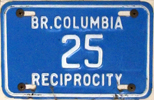
We are playing a hunch - albeit a well informed one - in classifying this 1962 plate as a prototype. First, it is the only known example from this year; the number on the plate, apart from being a nice round number, is higher than the average number of plates issued during its use (i.e. no more than 400 a year throughout the 1970s; and it appears to have never been issued. |
There are more than a few gaps in our knowledge of the Reciprocity plates, and it is assumed that the plates shown below, despite not showing a date, are from 1963 & 1964 based pon their colour schemes. Until more plates from this period become available to us, it is not known how long these plates were undated. |
| 1963
- 1964 |
|
|
|
|
Issuing
Statistics |
1963:
|
unknown |
1964: |
1 to 100 |
|
|
| 1965
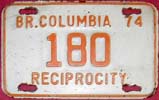
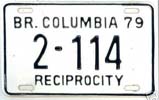
- 1979 |
1965 |
1966 |
1967 |
1968 |
Issuing
Statistics |
1965: |
1 to 150 |
1966: |
1 to 400 |
1967: |
1 to 400 |
1968: |
1 to 400 |
1969: |
1 to 400 |
1970: |
1 to 400 |
1971: |
1 to 400 |
1972: |
1 to 400 |
1973: |
1 to 400 |
1974: |
1 to 400 |
1975: |
401 to 800 |
1976: |
801 to 1200 |
1977: |
unknown |
1978: |
unknown |
1979: |
unknown |
|
|
1969 |
1970 |
1971 |
1972 |
|
|
1975 |
|
|
|
|
|
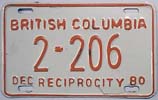
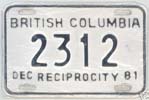
It is interesting to note that a December expiry date was added to the plates after 1979, and the full name of the province - "BRITISH COLUMBIA" - was finally spelled out. |
| 1980
- 1981 |
|
|
|
|
Issuing
Statistics |
1980: |
unknown |
1981: |
unknown |
|
|
*
* * * * |
It is thought that the end of Reciprocity plates coincided with the negotiation of the Canadian Agreement on Vehicle Registration (CAVR) by the various provincial Ministers of
Transport in Toronto on October 2, 1980. The first phase of
the Agreement formally took effect on April 1, 1982 - hence the emergence of the first BC "CAVR" decals in 1982. |
| CAVR Plates & Decals |
|
|
| This "Bingo" plate, which would have likely been attached to the front of a commercial truck operating across provincial boundaries is thought to show the transition from the previous reciprocity agreement to CAVR with the change in decals between 1981 and 1982. |
To read more about CAVR, visit our CAVR page filed under the "Prorate" section of the web-site, just: Click Here. |

© Copyright Christopher John
Garrish. All rights reserved.
|
.jpg)
.jpg)
.jpg)
.jpg)
.jpg)
.jpg)
2.jpg)