|
British
Columbia Antique License Plates

At
the time of their introduction in 1966, British Columbia was
celebrating the centennial anniversary of the unification
of the Colony of Vancouver Island with the mainland Colony
of British Columbia, and
was one year away from celebrating the centennial of Canadian
Confederation. B.C.'s federation with Canada would not occur
until 1871 - which is duly noted on the 1971 validation decal.
According to the province, many of the public occasions that
would be held over the next two years would be enlivened through
the participation of vintage cars. As such cars were not on
the road everyday, a permanent plate was designed - in part,
at the suggestion of the owners of these cars. |
The
plates also marked a first, of sorts, for British Columbia.
For years, the province had been seeking some method in
which to introduce a form of "lifetime plates." While the nature
of these Antique plates obviously limited their applicability
as a general issue, for those who qualified, the $20 fee
brought with it a license plate that would never need to
be re-validated; they would be permanent and would stay
with a car till it could go no more!
|
| 1966-1972: Three Digit Plates |
|
|
|
|
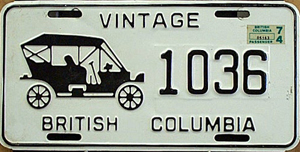
At
the time of their release, Antique plates were reported to
be starting at number 101, to be issued in sequential order
thereafter (Vancouver recieved plates 101-199, and Victoria
200-299). The die type for
all three-digit plates is noticeably larger than for the four-digit
plates (such as the one pictured at right). They all display
the word 'Vintage' on top-center, with British Columbia along
the bottom center. The
plates are also adorned with an embossed image of an old motor
carrier. |
It is thought that after this, Vancouver area motorists receiving these plates received pairs from the bloc starting at 400. |
|
| 1972-1974: Single & Double Digit Plates |
|
|
|
|
 |
|
|
|
| |
 |
|
|
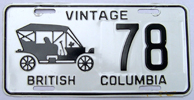
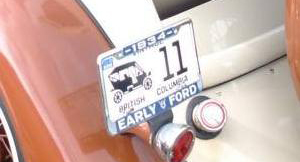
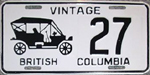
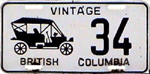
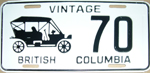
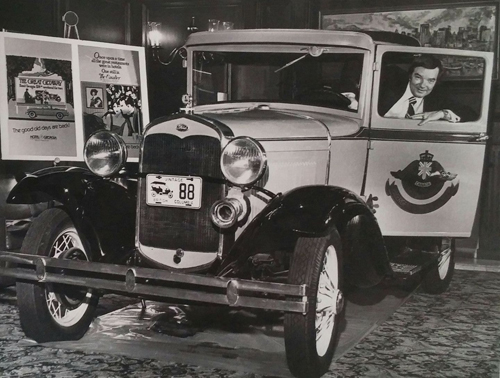
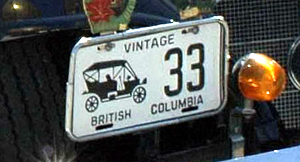
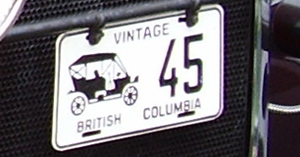
Shown here are a series of 2-digit Antiques out in the wild, with the No. 88 photographed sometime in the 1970s. |
An interesting, and as yet unexplained issuance appears
to have occurred in the early 1970s. An authentic Motor Vehicle
Branch box (used for storing plates), and labeld "Vintage"
with the date 7/5/1973, that yielded plates numbered: 51-75
has been brought to this writer's attention. Employing the
original, bigger die type, is it possible these were produced
at the end of the 101-999 run before the switch to the smaller
dies? Does this series technically start at No. 1, or
was a No. 1 even prodcued? These are questions that remain
to be answered .... |
 |
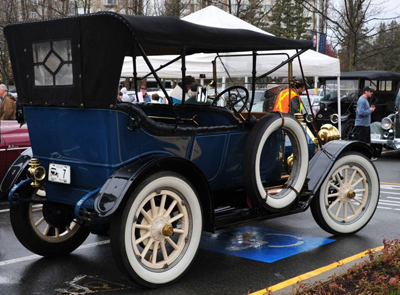 |
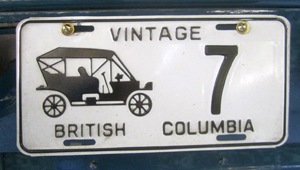
| The illusive single digit Antique vehicle license plate! After years of searching a specimen has finally been spotted (2013-03-31) and submitted to the BCpl8s.ca labs for further examination. |
| 1975-present: Four Digit Plates |
|
|
|
|
|
|
|
|
 |
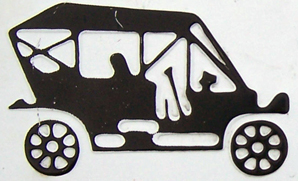 |
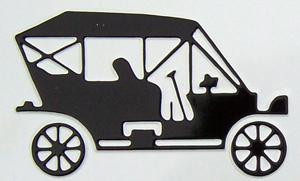
A minor design change occured in the four digit range (somewhere between 1500 and 2500) as the antique car was fitted with a different set of rims. While interesting, this is considered to be an insignificant modification ... |
| Sample, Prototype & Paint Test Plates |
|
|
|
|
|
|
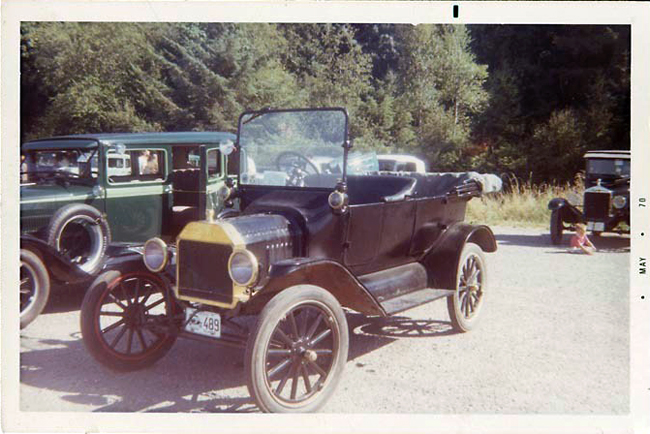 |
| In this image, taken in May of 1970, a number of antique vehicles are assembled for what is believed to be either a parade or car show. Shown prominently on the vehicle in the foreground (at centre) is Antique plate No. 489. |
| Decaled Plates |
|
|
|
As is evident from these plates, at some point in the mid-1970s the province appears to have required that validation declas be attached to Antique plates, which is very odd as these were always intended to be permanent plates that would not require revalidation. Or, possibly, some collector was up to no-good with some left-over decals ... |
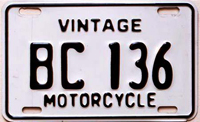
A month after
their release in 1966, nineteen Victoria residents had applied
for the plates, and today the series is roughly into the high
four digit range, and can also be seen, on occasion, as motorcycle
plates. One of the more amusing quotes from the early days
of this issue came from the Attorney-General, who felt compelled
to state that the plates were not meant to be displayed by,
or denote the Liquor Control Board. A misconception that was
obviously being fueled by the word 'Vintage' displayed at
the top of the plate. |
| Antique Motorcycle License Plates |
|
|
|
|
| Redesigned Antique Motorcycle License Plates |
|
|
|
|
| Antique Motorcycle License Plates: Waldale Dies |
|
|
|
|

© Copyright Christopher John
Garrish. All rights reserved.
|

.jpg)
.jpg)
.jpg)
.jpg)
.jpg)
.jpg)
.jpg)
.jpg)
.jpg)
.jpg)
.jpg)
.jpg)
.jpg)
.jpg)
.jpg)
.jpg)
.jpg)
.jpg)
.jpg)
.jpg)
.jpg)
.jpg)
.jpg)
.jpg)
.jpg)