
British Columbia Passenger License Plates
1904 - 2004
(and beyond!)

|
1904
- 1912
Although the first automobiles began to appear in British Columbia by the late 1890s, it would not be until 1904 that the provincial government formally began to regulate their use through the enactment of the Act to regulate the speed and operation of Motor Vehicles on Highways. This required that motorists prominently display their registration numbers on their vehicle, but that it was up to each motorists to produce their own "license plates" - accordingly, this is colloquially known as the "pre-provincial era". |
1913
- 1914
With the number of registered vehicles well into the thousands - and growing - an amendment to the Act to regulate the speed and operation of Motor Vehicles on Highways, was passed in 1913 that allowed the Superintendent of Provincial Police to issue two number plates to each registered vehicle bearing "the licence number of such motor, the initials 'B.C.' and the year of issue. Such number plate shall be of a distinctly different colour for each year ... and there shall be at all times a marked contrast between the colour of the number plate and that of the numbers and letters thereon." Thus marked the beginning of provincial standardisation of license plates, with the first plates being made of porcelain ... |
|
|
1915
- 1917
Due to the requirements of the war effort after Canada's entry into the Great War on August 4, 1914 (when Britain declared War on behalf of the Empire) the heavy guage steel and porcelain plates used between 1913-14 gave way to a much lighter series of tin plates with a wire frame between 1915 and 1917. These plates proved particularly ill-suited for BC's rugged climate and did not stand up well over the course of a year. |
1918
- 1923
Due to on-going material shortages associated with the War, the province undertook its first experiment with a renewable license plate in 1918. The plates for this year came pre-stamped with slots for a renewal tab to be issued in 1919. The system would be used again with a new base plate from 1920 through to 1922 before being abandoned in 1923. Interestingly, the 1921 tab with matching base plate became one of the rarest of all BC license plates as a result of this renewal system. |
|
|
1924
- 1935
In 1924, "BC" was expanded to read "British Columbia" and the basic layout of the plates would remain unchanged for the better part of the coming decade. One of the most noticeable changes, however, is in the use of dies that appear in these years, and which were principally intended to thwart counterfeiters. In 1930 vehicle registrations would surpass 100,000 for the first time, leading to the introduction of the first 6-digit licence plates. The onset of the Great Depression, however, would see vehicle registrations slowly decline throughout the remainder of this period. |
1936
- 1948
Stylistically similar to the plates that appeared between 1924 and 1935, the years 1936 to 1948 would see very consistent approach to plate design, with the most notable feature of the period being the issuance of only a single license plate to motorists between 1942-47 (again due to material shortage associated with the war in Europe). As vehicle registration again surpassed the 100,000 mark, the province decided to implement a different approach to dealing with registrations by employing a letter prefix for passenger vehicles from 1940 through 1948. |
|
|
1949
- 1951
Between 1942-48,
the province had only issued single license plates in
an effort to conserve materials for the war, the 1949
base marked a return to motorists being issued pairs.
What is also unique about the '49, and 1950 bases is
that 5-digit plates came in one size, while 6-digit
plates were issued in another size. Due to the outbreak
of war in Korea, motorists were only issued a metal
renewal strip for 1951. |
1952
- 1954
The ill-fated
Totem series! One of the most unique license
plate designs ever used in Canada, the Totem base would last for just over a year before the province
decided to scrap it due to widespread theft of the renewal
tabs, the low resiliency of the aluminum, and the nightmarish
alphanumeric serial used on the plates. |
|
|
1955
- 1963
This period
is noted for some of the wildest colours ever seen on
license plates. Between 1959 and 1962 the province used,
prominently and in varying combinations the colours
Turquoise, Maroon and the green/gold of the Centenary
plate. This series only employed the one to six digit,
000-000 serial format. If I am not mistaken the Centenary
plate is also the only regular issue BC plate to ever
commemorate an event. |
1964
- 1969
British Columbia
becomes Beautiful, as 1964 is the first year
that the word beautiful appears on a license plate!
This is also the period in which a new, official colour
rotation scheme took effect, and the last years for
the 000-000 format as vehicle registration neared the
one-million mark. |
|
|
1970
- 1972
The year 1970
marked a watershed in BC plates. Unlike past years,
the Province adopted the alpha-numeric, AAA-000 system
with these plates. As well, as was happening in jurisdictions
all across North America, BC scrapped the year stamped
plate in favour of the new decaled version. The slogan
"Beautiful British Columbia" was maintained,
but these plates would now have a designated decal area. |
1973
- 1978
As the first
stage in the transition to an alphanumeric system, the
initial 1970 base was only intended to last three years.
For 1973, the second stage was commenced with a base
plate that held slight modifications, most notably in
the positioning of the decal box, and the use of a dash
separator. |
|
|
1979
- 1985
The brand
new 1979 base! This particular style would last all
of seven years, which is a very short period if one
considers the life span of the flag graphic has been
16 years and counting! This series started with: AAA
- KKJ, and experienced a variety of different dies.
Position of the sticker box is also firmly established
in the lower-center of the plates with this series. |
1985
- 2001
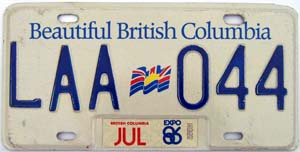
The Flag Graphic.
BC undertook a complete re-issue in time for the 1986
World's Fair held in Vancouver (as testified to by the
validation sticker at right). The 'Beautiful' slogan
is retained, now appearing across the top of the plate.
The sticker box is still lower-center but is now debossed.
And, of course, the highly stylized graphic of the provincial
flag seperating the alpha-numeric serial format. This
specific serial started in the L's and ended in the
K's. |
|
|
2001
- 2013
When ICBC ran
out of the AAA-000 combinations it considered
the option of re-issuing previously assigned or terminated
licence plate numbers but decided to continue its "one
person/one time" policy for assigning plates. To
do this plates now come in the 000-AAA serial format.
Unfortunately, this gave the 'Flag Graphic' an 8 million set lease on life (with estimates being that available combinations will run out some time in 2013). In 2002, production of the plates was shifted from Astrographics of Surrey, BC to Waldale of Amherst, Nova Scotia. |
2013 and beyond!
Unlike in 2001 when ICBC only issued a news release on the change over from the "AAA-000" to a "000-AAA" format after plates had begun to be issued, with the impending exhaustion of the "000-AAA" expected in 2013, an announcement was made in mid-2010 regarding the future. Effectively, there would be no new design and no seventh digit, instead a "AA0-00A" serial format would be introduced to create an additional 8,000,000 combinations (or another 8-10 years supply). |
|

© Copyright Christopher John
Garrish. All rights reserved.
|