|
British
Columbia Commercial Truck License Plates

A
special thanks to Neale Hankins, Bill Hobbis, Tom Lindner, Dallas Doyle and Ron Garay for providing many of the plates pictured.
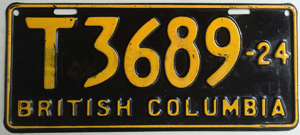
The second license plate prefix to be issued in British Columbia was the short-lived "T" for Trucks, which was used only for the 1924 registration year (the first prefix being the "D" for Dealer plates in 1911). It is not clear what fate befell these early "T" plates, but they form an interesting precursor to the eventual classification of Commercial Trucks in subsequent decades. |
.jpg) |
The Truck pictured above is displaying Registration No. T2211
Image Credit: Saanich Archives
Caption: "Saanich Poundkeeper and Ford truck in front of Glanford Avenue pound 1924"
Archives Number: 1980-005-032 |
|
Thanks
to Pierre Delacote, we are able to provide an example of the
registration form issued to a Truck sporting a "T" plate. Simply
click on the image below to read more: |
|
|
*
* * * * |
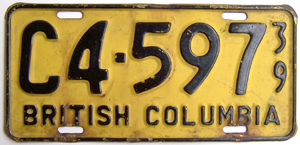
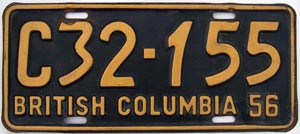
In 1936, the province would again create a separate registration for Commercial Trucks through the introduction of the "C" prefix, which would appear continuously through to 1971. |
Of interest, although the province had used issued six-digit passenger plates between 1930 and 1935 as way to extend that series beyond the 99,999 mark, the decision was made to retain the five-digit format for the Commercial series and use additional letters to extend the "C" prefix beyond the 9,999 mark. As a result, in the very first year of issue approximately thirteen (13) different letter combinations appear on the "C" plates - a number which would only increase as the number of trucks continued to grow throughout the coming decade.
|
| 1936
- 1948: Multiple Letter
Prefixes |
|
|
|
|
|
| Issuing
Statistics |
| 1936:
|
C1
to CP-800 |
| 1937:
|
C1 to CS-255 |
| 1938:
|
unknown |
| 1939:
|
unknown |
| 1940:
|
C1 to CY-878 |
| 1941:
|
C1 to CX-999 |
| 1942:
|
C1 to C900A |
| 1943:
|
C1 to C999A |
1944:
|
C1 to C515B |
1945:
|
C1 to C685E |
1946:
|
C1 to C999N |
1947:
|
C1 to C185Z |
1948:
|
C1 to C1Y99 |
|
|
|
|
|
|
|
|
|
|
|
|
|
|
To see how the various prefixes were issued in each year, simply click on the plates shown above to access the Gallery. |
|
|
The plate shown at left is thought to be a manufacturers sample due to the use of the three zeros and the fact that it as never painted. |
*
* * * * |
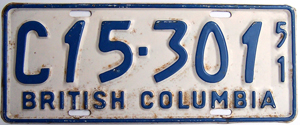
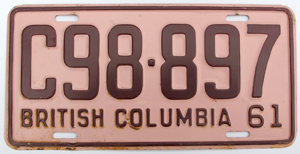
In an attempt to simplify the registration system, the province did away with the use of excessive letter prefixes on both the passenger commercial plate series in 1949. Consequently, the only letter prefix that would now appear on Commerical vehicles would be "C", however, to meet demand, the province resorted to the use of two different sized plates (i.e. a short version for five-digit serials and a long version for six-digit serials). |
| 1949
- 1951 |
|
|
|
|
Issuing
Statistics |
1949:
|
C1 to C55-250 |
1950:
|
C1 to C59-400 |
1951:
|
C1 to C65-000 |
|
|
.jpg)
1949 Commercial License Plate - Short Version |
.jpg)
1949 Commercial License Plate - Long Version |
*
* * * * |
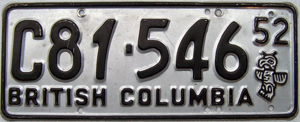
The ill-fated Totem base! A striking plate in terms of its auluminum design, but totally ill-suited to British Columbia's rugged climate and was ultimately done in by its poorly conceived renewal tab system. Originally intended to last for a period of five years, the plate was abandoned within 18 months and while the passenger series would be renewed by tab in 1954, the Commercial series was issued a whole new plate (or different material) in 1954. |
| 1952
- 1954: "Totem"
Base |
|
|
|
|
Issuing
Statistics |
1952:
|
C1 to C90-000 |
1953:
|
400001 to 485000* |
1954:
|
C1 to C90-000 |
|
* Renewal Tabs were issued in 1953 instead of license plates. |
To see a Gallery displaying how the various prefixes were issued in each year, simply Click Here. |
What sets the Commercial version of the Totem base apart from the Passenger is the absence of the maple leaf encompassing the thunderbird totem - principally due to space constraints. |
A minor design variation is visible in later issues where the "52" date stamp has been removed. It is thought that the transition occured after the 90,000 mark and reflects plates issued in 1953 (and which would have been validated through the use of the tab): |
.jpg)
1952 Base - Dated Version |
.jpg)
1952 Base - Undated Version |
|
The series is known to have progressed beyond the 99,999 mark and was extended through the use of a "CA" prefix (above). Due to space contraints, the Commercial base was also required to use a separate renewal tab in 1953 (at right). The obvious differences are the absence of the maple leaf and the spacing of the date, with the less obvious difference being the placement of the registration number (which is vertical on the Commercial tab and horizontal on the Passenger tab).
|
|
.jpg)
1953 Commercial Tab |
.jpg)
1953 Passenger Tab |
|
This
plate was rejected due to a defect under the five in
"52". |
| 1955
- 1956 |
| |
|
|
|
Issuing
Statistics |
1955:
|
C1 to C95-000 |
1956:
|
unknown |
|
|
To see a Gallery displaying how the various prefixes were issued in each year, simply Click Here. |
| 1957
- 1963 |
| |
|
|
|
Issuing
Statistics |
1957:
|
unknown |
1958:
|
unknown |
1959:
|
unknown |
1960:
|
unknown |
1961:
|
unknown |
1962:
|
unknown |
1963:
|
unknown |
|
|
|
|
|
|
To see a Gallery displaying how the various prefixes were issued in each year, simply Click Here. |
*
* * * * |
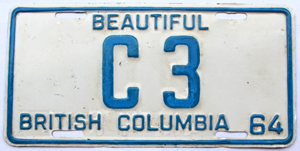
1964 would mark the introduction of the "Beautiful" slogan, but also the last year that two letter prefixes would be used as a new single letter prefix, "J" would start be used following the exhaustion of the "C" prefix in 1965. |
As Commercial vehicle registrations surpassed the 200,000 mark in 1971,
the letter "K" prefix was introduced
to help prolong the series. |
| 1964: "Beautiful"
Slogan |
|
|
|
|
| Issuing
Statistics |
| 1964:
|
C1
to C99-775 |
| |
CE1 to CE9-999 |
| |
CH1 to CH9-999 |
| |
CJ1 to CJ6-775 |
|
|
| |
|
|
|
| 1965
- 1971: Additional Single Letter Prefixes |
|
|
|
|
Issuing
Statistics |
1965:
|
C1 to C90-000 |
| |
J1
to J43-900 |
1966:
|
C1 to C96-000 |
| |
J1 to J48-000 |
1967:
|
C1 to C99-999 |
| |
J1 to J49-500 |
1968:
|
C1 to C99-999 |
| |
J1 to J62-000 |
1969:
|
C1 to C99-999 |
| |
J1 to J81-800 |
1970:
|
C1 to C96-000 |
| |
J1 to J99-500 |
1971:
|
C1 to C99-999 |
| |
J1 to J86-000 |
| |
K1
to K37-000 |
|
|

CLICK HERE |
|

CLICK HERE |
|
|
|
|
|
|

CLICK HERE |
|
|
| 1965: Decal Box Variation |
|
|
The majority of the 90,000 Commercial license plates produced in 1965 with the "C" prefix are like the one shown at left, however, it is also possible to find a small bloc of plates issued early in the series with a sticker decal box in the bottom centre of the plate and a different type used on the date in the top right-hand corner. |
It is thought that these plates are related to work that was being undertaken by the Plate Shop at Oakalla in anticipation of the introduction of a multi-year plate that was to be renewed through the use of a plastic registration decal. It is now know, through separate correspondance between Oakalla and the Yukon Registrar of Motor Vehicles that the Plate Shop had "purchased material that has proven to be satisfactory for periods of up to four years" and could be used with a renewal decal - "as is being employed in many of the provinces and states today". The cost of these decals was estimated at $0.07 (which included packaging in a small cellophane envelope). |
| 1967: Overrun |
Despite the introduction of the "J" prefix, Commercial plates continually ran over the allotted combinations by the late 1960s. As with the passenger plates, when the 1967 "J" plates exceeded the 49,500 combinations initially produced, the province began using the 1968 base for over-run. We know this because of the appearance of "19" in the top left-hand corner of the plates. |
| |
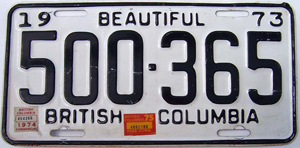
It
is thought that the 1973 Truck series commenced at number
500,000. As such, the plate shown above at far left would
have been an early issue in 1973, and was used through 1975
(as evident by the decals). By 1974, the series had progressed
through the 800,000 mark, and by 1975 the series surpassed
the 999,999 mark. After plate 999,999 was issued an over-run
series was produced and it is believed that these commenced
at either 30,000 or 35,000. |
| 1973
- 1975 |
|
|
|
|
Issuing
Statistics |
1973:
|
500-001
to 764-000 |
| 1974: |
unknown |
1975:
|
unknown to 999-998 |
????
|
over-run |
|
|
| 1976
- 1978 |
|
|
|
|
Issuing
Statistics |
1976:
|
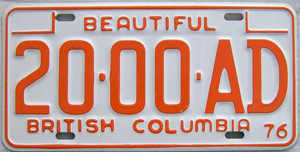
00-01-AA
to 00-00-EC |
|
|
To see how the series progressed, simply click on the letters shown above. |
|
|
| 1979
- 1986 |
|
|
|
|
Issuing
Statistics |
1979:
|
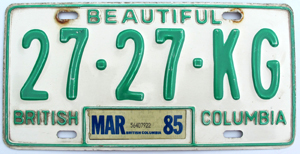
00-01-FA
to 99-99-LY |
|
To see how the series progressed, simply click on the letters shown above. |
|
|
|
|
|
|
| |
|
|
|
| Alternate Base Materials |
|
|
The
two plates pictured above show how the province experimented
with both a Reflectorized base plate for commercial
vehicles (at left) in the early 1980s, and the more
traditional painted white base plate (at right). It is not clear who the manufacturer of each plate was, but it is assumed to be different companies due to the dies used on each plate. |
| Error Plate |
| |
|
It is not often you find a British Columbia error plate, but the example shown above-left is just such a rare bird. As can be see, the plate displays a two letter prefix, whereas the series otherwise uses a two letter suffix - such as is shown on the plate at right. |
*
* * * * |
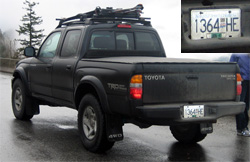
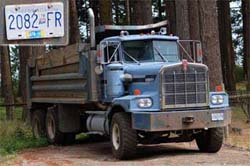
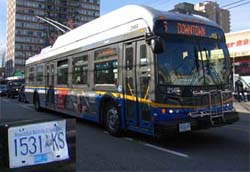
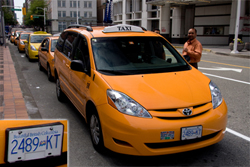
One of the more interesting aspects of this particular plate type is that, since its (re)introduction in 1936, the province has continued, in one form or another, to refer to it as a "Commercial" plate up to the present day. |
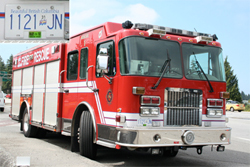
Yet, anecdotal evidence would seem to suggest that the vast majority of vehicles that display this type of plate are decidely non-commercial in nature and can be characterised as private pick-up trucks used for personal use. The category also encompasses emergency services vehicles such as municipal fire trucks, and public bus services. |
Due to these variances, despite the proper title under the current Allocation Code used by ICBC terming these plates as "Commercial Truck", it can also refer to what the Corporation calls "light commercial trucks" (thereby encompassing personal vehicles). |

Pick-ups |

Heavy Trucks |

Buses |

Taxis |

Fire Trucks |
|
| 1985
- 2009 |
|
|
 |
 |
Issuing
Statistics |
1985:
|
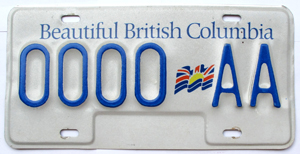
0000-MB
to 9999-RE |
1986:
|
0000-RF to 9999-SY |
1989:
|
0000-TA to 9999-TH |
1990:
|
0000-TJ to 9999-VH |
1991:
|
0000-VJ to 9999-WC |
1992:
|
0000-WD to 9999-XM |
1993:
|
0000-XN to 3999-YG |
1994:
|
4000-YG to 9999-YG |
1994:
|
0000-AA to 3999-AC |
|
To see how the series progressed, simply click on the letters shown above. |
|
|
|
|
|
|
 |
 |
 |
|
 |
 |
 |
 |
|
|
|
|
|
|
|
|
|
|
2009 |
|
| Veteran Base: |
In 2004, the Commercial Truck plate type was included as one of the plate types that would be made available as part of an initiative by the British Columbia to recognise the service of "Veterans" to their country. |
.jpg)
Veteran Commercial Truck license plate |
It is thought that ICBC has set aside the "LV", "LW", "LX" and "LY" suffixes for use on the Veteran base - which represents approximately 40,000 plates (as of May 2010 - or six years into the program - only 6,700 Veteran Truck plates have been issued). Interestingly, this bloc represented the last of four suffixes available in the Truck series under the 0000-XX format. |
| Olympic Base & Allocation: |
In 2007, the Commercial Truck plate type was one of the lucky six plate types - along with passenger, farm truck, motorcycle, trailer and utility trailer - to be made available on the optional 2010 Olympic Winter Games base. |

Olympic Commercial Truck license plate |
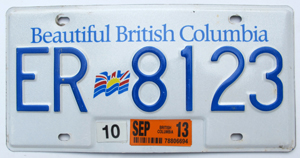
Of particular interest was that, at the time of the Olmypic release, the Commercial Truck series was still utilising the "0000-XX" serial format. It is suspected that "AA-0000" through to
"AK-9999" (which represents approximately 100,000 sets) has been reserved for the Olympic
base, however, it is unlikely that all of these will be required and the leftover allotment will be reissued under the "Flag" graphic sometime after December 31, 2010. |
The
Truck series is dead, long live the Truck series! |
On
February 20, 2008, this writer saw the first of the new AA-0000
series Truck bases (Olympic bases not included). |
As
expected ICBC has simply reversed the series (a la the passenger
series in 2001) and appears to have started it in the AL-0000
range - which indicates that "AA-0000" through to
"AK-9999" has likely been reserved for the Olympic
base. As with the Olympic & Consular bases, ICBC has also implemented
the separated, or dual decal box for the day and month/year
decals. |
This move breaks
the alphabetic trend started way back in 1976 with each
iteration of the Truck base starting off where the previous
series ended. For instance, the '76 base ceased at "D"
(or possibly the "E" range), and the '79 base
starting at "F", before ending at "L",
whereupon the '85 base started at "M" and finished
at "L". Accordingly, the new serial should have
commenced at "M" again, however, it looks like
ICBC wanted to start with a clean slate. Interestingly,
the flag base and "Beautiful" slogan have been
retained in favour of the "Best Place on Earth"
slogan and logo... hmm... this deserves a query to the good
folks at ICBC.
|
|
| Decal Box Variations |
It
appears that, despite the initial "AL" plates in
this series being provided with the separted decal boxes for
the day and month/year decals as found on the Olympic and
Consular bases, a switch-back of sorts has occurred, whereby
it appears that plates in the "AM", "AN",
"AP", and "AR" range all employ the single
decal box as found on the Truck base before the 0000-AA series
ended. |
Dual
Decal Box Variation |
One
of our intrepid field spotters has been able to pinpoint this
change-over as occurring somewhere within the bloc of plates
found beetwen "AL-7324" (separated boxes) and "AL-8433"
(single box). |
It
is likely that only the manufacturer, Waldale, knows the precise
reason behind this change, however, we here at BCpl8s.ca suspect
that it is simply a matter of using up old stock prepared
for either the Agriculture and Industrial Vehicle bases prior
to a braoder implementation of the dual decal boxes onto all
plate types. Nevertheless, a call has been placed to the good
folks at ICBC to see if they can shed some light on this matter.
Stay tuned ... |

© Copyright Christopher John
Garrish. All rights reserved.
|