|
Lieutenant Governor of British Columbia's License Plate |
||||||||||||||||||||||||||||||||||||||||||||||

Quick Links: |

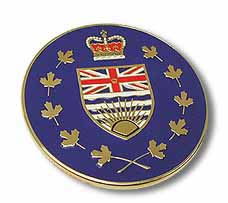
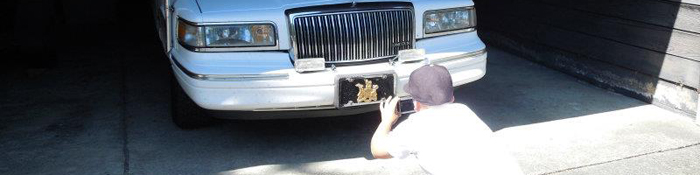
As a Parliamentary democracy the nominal head of British Columbia is not the Premier (as leader of the largest party in the Legislature) but is, in fact, the Lieutenant Governor (LG), who fills the role of representative of Her Most Excellent Majesty, the Queen of Canada in the Province of British Columbia. It is the Lieutenant Governor that personifies the Crown; is both the apex and the unifying link in the constitutional and political structure of the province; and, accordingly, takes precedence over everyone in British Columbia except the Sovereign! Despite being the constitutional source of state power in British Columbia, the LG's role has evolved over time to where it is now a largely symbolic one confined to being a goodwill ambassador on behalf of the Province. While there are undoubtedly many obligations put upon the LG to ensure not only the proper functioning of the government, but to fulfil an arduous ceremonial role on behalf of the province, it is not without its own interesting set of perquisites. As I like to point out to some of my American friends, whereas many US states have the established tradition of awarding plate No. 1 to the Governor, in BC our LG is not even required to use a license plate (ha-ha!). Yet, as anyone who has lived in Victoria knows, official trips by the LG are generally not an occasion for anonymity as their is usually some underlying formality to the outing (i.e. opening Parliament, shuttling dignitaries, etc ...). So, in order to distinguish the LG's car, a "die-struck plaque" of the Lieutenant Governor's Crest is attached to a blank base-plate and affixed to the official vehicle (as shown below): |
||
|
||
In terms of design, the Crest represents the British Columbia shield of arms surrounded by a circlet of 10 gold stylized maple leaves representing the 10 Provinces of Canada. Above the shield is a St. Edward’s Crown, signifying the Sovereign’s representative in the Province. As will be described below, this particular design has been in use since 2008. Of note, despite not having to obtain a license plate, the LG's car is, nevertheless, registered with ICBC and has been issued a standard passenger plate on the Flag Graphic base (HTJ-496) that is kept within the vehicle. It is assumed that this has been done for insurance and liability issues in case the vehicle was ever to be involved in an accident outside of official use. |
.jpg)
.jpg) |
.jpg) |
|
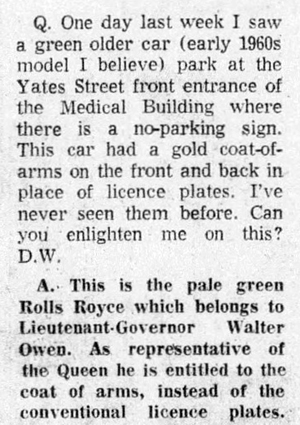 As can be seen is this letter to a local Victoria newspaper in the 1970s where readers were invited to "Ask the Times", the Lieutenant Governor's lack of a license plates has been confounding people for decades.
| Previous Lieutenant Governor License Plate Designs | |||
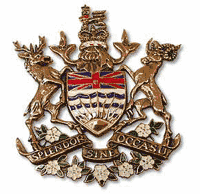
Historically, it is unclear when it was first prescribed that the LG need not worry about attaching a license plate to their vehicle. It is known that, until 1938, any ordinary citizen could apply for plate number one, but that after this date No. 1 was reserved for the official government car used for transporting dignitaries and the Premier (please see the page on Personalized plates for more info). When the numbering of plates was switched over to the alpha-numeric series in 1970, AAA-001 was reserved for the LG. Moreover, when the Flag Graphic was introduced in 1985/86, it has been rumoured that the first 100 plates went to "dignitaries", and that the practice of the LG receiving the first plate in the series was only ceased in the late 1990s during the term of Garde Gardom (1995-2001). So, I would suggest that there is strong reason to suspect that the LG did have the first plate in the Flag series (i.e. LAA-001), and that when this plate was removed from the LG's car, its replacement was a plate comprised of a large die-struck British Columbia Coat of Arms on a black base (which is not all that dissimilar to the plate currently in use): |
|||
|
|||
.jpg) ABOVE: The Lieutenant-Governor's Vehicle in 2003 and AT RIGHT:
The Lieutenant-Governor's Vehicle in 2016.
|
.jpg) |
||
This
particular style was used through 2008 before being replaced
by the current "Crest" plate. While it is not
known what prompted the switch, it is assumed to be related
to a desire to bring a consistent approach to the "branding"
of the LG's office. |
|||
|
|||
.jpg)
.jpg)
.jpg)
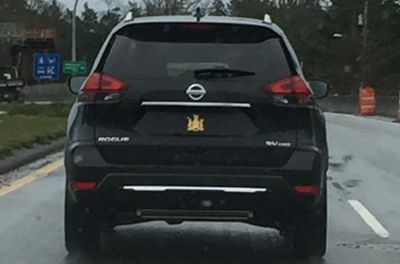 |
At left, the LG appears to have gone "Rogue", as in cruising around the province in a Nissan Rogue.
|
 |
A wholly understandable desire!
|
| The Lieutenant Governor's Golf Cart |
In certain instances, golf carts required to use a public highway must be registered with ICBC and display the proper “Restricted” vehicle licence plate (such as the cart shown below at right), which is identifiable by its unique colour scheme and use of either an ‘AT’ prefix or (as of 2010) an ‘X’ suffix. Not so with the Lieutenant Governor, as the official golf cart (shown below at right) is equipped with a similar crest as found on the other official vehicles: |
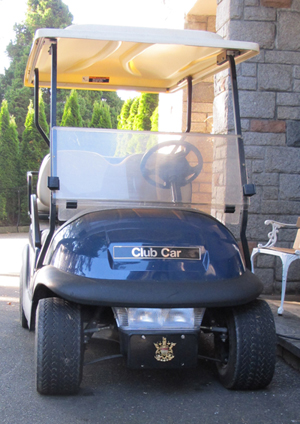 Lieutenant Governor's Golf Cart |
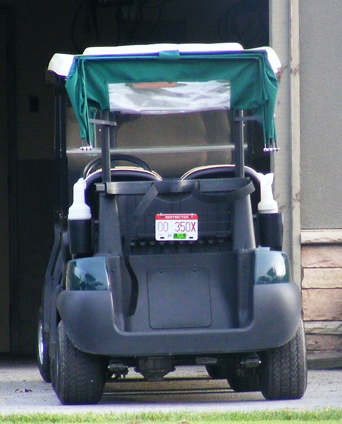 Standard Golf Cart with a "Restricted" plate |
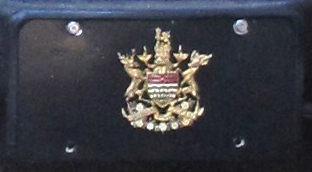 The Lieutenant Governor's Golf Cart License Plate |
|
| Personalized Plates? |
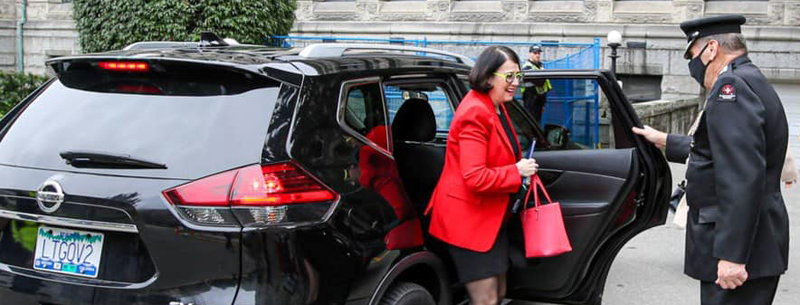
An odd sight at the 2022 Throne Speech; the LG showing up in her Nissan Rouge but inplace of the Coat of Arms that has been seen in the past was a personalized license plate with the slogan "LTGOV2", which leads us to believe there is possibly a "LTGOV" and "LTGOV1"? |
 |
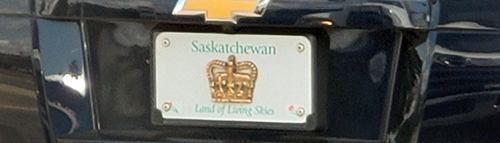
We can only speculate as to why the change, but in our opinion, and as much as we like vanity plates, it is too common and beneath the office of the Queen's representative. If our LG is to have a regular type of plate, we would rather see something like what Saskatchewan has done: |
 |
Quick Links: |

Antique | APEC | BC Parks | Chauffeur Badges | Collector | Commercial Truck | Consul | Dealer | Decals | Driver's Licences | Farm | Ham Radio | Industrial Vehicle | Keytags | Lieutenant Governor | Logging | Manufacturer | Medical Doctor | Memorial Cross | Motive Fuel | Motor Carrier | Motorcycle | Movie Props | Municipal | National Defence | Off-Road Vehicle | Olympics | Passenger | Personalized | Prorated | Prototype | Public Works | Reciprocity | Repairer | Restricted | Sample | Special Agreement | Temporary Permits | Trailer | Transporter | Veteran | Miscellaneous |
© Copyright Christopher John
Garrish. All rights reserved.