|
British
Columbia Amateur (Ham) Radio License Plates

"Ham:
a poor operator. A plug." |
|
|
|
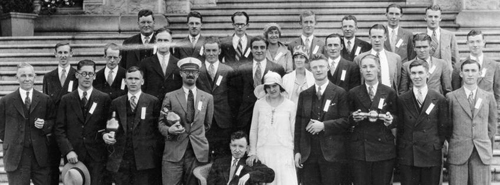
At far left is a photo of David Scholes, past Secretary of the Victoria Short Wave Club, at his radio, above is a photo of the Victoria Short Wave Club in 1932 and near left is a photo of Markus Hansen at his radio in the 1960s. |
Simply
put, an amateur radio operator is a person holding written
authorization to be the control operator of an amateur station.
A central facet of this communications system is the call
sign. As a member of the Empire, Canada, along with other
Colonies, were issued signs beginning with the letters "V"
shortly after the Great War. In Canada, the three-character
prefixes ranged from VE1 to VE0 and were assigned to the provinces
on an east-west basis. Therefore, the Maritimes were VE1,
Quebec was VE2 and British Columbia was VE7, and so on …
The
first license plates with amateur radio call signs on them
were issued by Michigan in 1939. Legislation there allowed
for a maximum of 3 letters and 3 numbers, corresponding with
the operators sign, but the format proved too complicated
for officials administering the program and Michigan discontinued
the plates the following year.
Support for the plates would
remain dormant until the 1950s and the beginnings of the Cold
War. The need to quickly identify experienced ham operators
in the event of an emergency became an important public safety
issue. Florida would issues the first true, or modern ham
plate in 1950 to be followed quickly by other state’s,
while the first Canadian plates would be issued in 1952.
|
 In
British Columbia, the impetus to authorize ham plates can
be traced back to the 1948 flood of the Fraser River, when
16,000 people were evacuated from the Upper Fraser Valley,
2,300 homes destroyed or damaged and all rail, road and air
connections to the east severed. Lacking any special
markings, ham operators with mobile equipment in their cars
were turned away by police and other authorities at the flood
zone, unable to get to their allotted positions and aid in
the rescue operations. In
British Columbia, the impetus to authorize ham plates can
be traced back to the 1948 flood of the Fraser River, when
16,000 people were evacuated from the Upper Fraser Valley,
2,300 homes destroyed or damaged and all rail, road and air
connections to the east severed. Lacking any special
markings, ham operators with mobile equipment in their cars
were turned away by police and other authorities at the flood
zone, unable to get to their allotted positions and aid in
the rescue operations.
For years afterwards, Stanley Carnell,
the M.L.A. for Peace River and a ham operator himself, lobbied
the Legislature every spring during license plate renewals
for a special ham plate. At right is a newspaper column from 1959 reporting on yet another decision by the provincial government to not issue special plates for amateur radio operators. Below is a cartoon, also from 1959, that we believe reveals the pessimism that coloured hams hopes of when they might finally receive special license plates.
 Only belatedly, after Carnell had
shamed the provincial government by declaring that every other
Canadian province and forty-six of fifty states had the plates
did B.C. institute their own in 1963. Attorney-General Robert
Bonner was quoted at the time as saying that; “if we
are in fact the last province, I think we should review our
position.” Only belatedly, after Carnell had
shamed the provincial government by declaring that every other
Canadian province and forty-six of fifty states had the plates
did B.C. institute their own in 1963. Attorney-General Robert
Bonner was quoted at the time as saying that; “if we
are in fact the last province, I think we should review our
position.”
It
was estimated that of British Columbia’s 1,500 amateur
radio operators in 1963, about 120 would apply for the special
license plates. As the province’s designation was VE7,
this would appear as the first prefix on all ham plates, to
be followed by the users own two or three letters to complete
the sign. More importantly, ham radio license plates would
be the first specialty plates ever issued in British Columbia.
|
|
| |
February of 1963: B.C. Attorney-General, Robert W. Bonner (center) presents BCARA President George R. Kitson, VE7ALE, with the first call-sign licence plate. L-R, Jack Striha, head of MV Licence Issuing Division; Reginald James R. Tate, VE7DW, Chairman of Licence Plate Committee. Background, Peace River South Social Credit MLA Stan Carnell, VE7GE, who introduced a private member's bill, but was opposed. However, Stan's four years of political persuasion prompted the A-G's personal interest ... and Ray Tate's mental persistence became VSWC's February, 1963 reality.
|
|
|
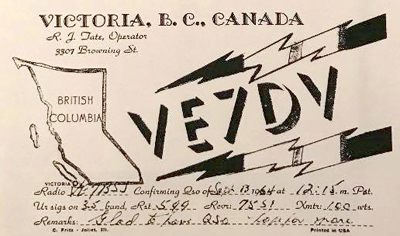
As noted above, one of the first to obtain a new Amateur Radio license plate in 1963 was Ray Tate of Victoria. Described by his peers as "an extraordinary member [of the Victoria Short Wave Club], a man of political idealism; the VSWC would never have been the same without him. A knowledgeable, talkative electronics man, he was a gifted craftsman who could produce HAM equipment of the finest quality ..." Ray also happened to be the Chairman of the VSWC's Licence Plate Committee in 1963.
|
After obtaining his first Amateur Radio plates, it was report that:
He drove around town for three hours with his licence plates and not one policeman gave him so much as a wry look. B.C. Forest Service radio technician R.J. Tait, 3307 Browning [Street], was the first B.C. amateur radio station operator to display car licence plates carrying his call letters "VE7 DV" ... Mr Tait thought that the initial appearance of his "VE7 DV" would cause a stir. But nobody paid him any attention.
|
|
We can only assume that this was no accident and a little touch of subversiveness by George Kitson! Read the following caption that accompanied the photo and see what you think;
Ham Radio operators with mobile communication equipment will have their own distinctive license plates for the first time in B.C. this year. Plates, specially made for the Motor Vehicle Branch, carry call letter of individual amateur operators, are issued only to those with equipment installed in their cars. Plates were requested by the B.C. Amateur Radio Operator's Association, which is committed to providing temporary communications in the event of emergency. About 120 plates will be issued. Inspector George R. Kitson of Vancouver Police (above) received his plates in Victoria Thursday. (February 7, 1963)
A police detective with an Amateur Radio call sign that includes a reference to alcohol? Things that make us go "Hmmmm ..."
|
 In March of 1963 the following was reported: In March of 1963 the following was reported:
The man largely responsible for getting B.C. amateur radio operator's call letters on auto licence plates was honored at a special dinner at the weekend. Jack Striha, Motor Vehicle Branch senior clerk, was guest of honor when 44 hams gathered at Tally Ho. They also put in the spotlight others who have aided the cause of amateur radio here: Ted Wills, of Western Agencies; Jack English of Ellison Queale Radio Supply; Charlie Hewitt of Hygrade Radio. Hams and guests came from abroad to attend the function. There was the country's acknowledged top ham Billy Wadsworth, VE7ZM, of Duncan, who is famed for his many wireless contacts with distant lands. Stanley Carnell, MLA for Peace River South, VE7GE; A.G. Sheffiled, VE7CB, Fulford Harbour; M.H. Anderson, VE7HM, Bridge River; Ted Toye, Vancouver, and Pete Heline, Duncan, were others introduced by Victoria Short Wave Club president, Brent Ewing, VE7AAF. They also put in the spotlight others who have aided the cause of amateur radio here: Ted Wills, of Western Agencies; Jack English of Ellison Queale Radio Supply; Charlie Hewitt of Hygrade Radio. Hams and guests came from abroad to attend the function. There was the country's acknowledged top ham Billy Wadsworth, VE7ZM, of Duncan, who is famed for his many wireless contacts with distant lands. Stanley Carnell, MLA for Peace River South, VE7GE; A.G. Sheffiled, VE7CB, Fulford Harbour; M.H. Anderson, VE7HM, Bridge River; Ted Toye, Vancouver, and Pete Heline, Duncan, were others introduced by Victoria Short Wave Club president, Brent Ewing, VE7AAF.
|
An interesting facet of amateur radio call signs when license plates were first issued; operators could not pick their own letters. These were assigned in sequential order, so all of the two character call signs would have been assigned prior to moving into the first block of three character call signs starting with "VE7-Axx". Which explains why there are only three-character plates in the "VE7-Axx" and "VE7-Bxx" block in the 1960s and into the early 1970s. It is unknown to us at BCpl8s.ca why the "VE7-Cxx" block appears to have been held back in this period ... |
| 1963: First Issue |
|
|
|
|
Issuing
Statistics |
Initial Series:
|
Not applicable |
Registered:
|
Unknown |
Over-run:
|
|
Issued:
|
Pairs |
Manufacturer:
|
Oakalla Prison |
Dimensions:
|
302 mm x 150 mm |
Material:
|
Steel |
Comments: Plates were issued on an "as needed" basis when requested by licenced amateur radio operators. |
|
|
|
|
|
|
| 1964: "Beautiful"
Slogan |
|
|
|
|
Issuing
Statistics |
Initial Series:
|
Not applicable |
Registered:
|
Unknown |
Over-run:
|
|
Issued:
|
Pairs |
Manufacturer:
|
Oakalla Prison |
Dimensions:
|
302 mm x 150 mm |
Material:
|
Steel |
Comments: Plates were issued on an "as needed" basis when requested by licenced amateur radio operators. |
|
|
|
|
|
|
| 1965 |
|
|
|
|
Issuing
Statistics |
Initial Series:
|
Not applicable |
Registered:
|
Unknown |
Over-run:
|
|
Issued:
|
Pairs |
Manufacturer:
|
Oakalla Prison |
Dimensions:
|
302 mm x 150 mm |
Material:
|
Steel |
Comments: Plates were issued on an "as needed" basis when requested by licenced amateur radio operators. |
|
|
|
|
|
|
|
|
|
|
|
| 1966 |
|
|
|
|
Issuing
Statistics |
Initial Series:
|
Not applicable |
Registered:
|
Unknown |
Over-run:
|
|
Issued:
|
Pairs |
Manufacturer:
|
Oakalla Prison |
Dimensions:
|
302 mm x 150 mm |
Material:
|
Steel |
Comments: Plates were issued on an "as needed" basis when requested by licenced amateur radio operators. |
|
|
|
|
|
|
|
|
|
|
| 1967: Canadian Centennial (National Colours) |
|
|
|
|
Issuing
Statistics |
Initial Series:
|
Not applicable |
Registered:
|
Unknown |
Over-run:
|
|
Issued:
|
Pairs |
Manufacturer:
|
Oakalla Prison |
Dimensions:
|
302 mm x 150 mm |
Material:
|
Steel |
Comments: Plates were issued on an "as needed" basis when requested by licenced amateur radio operators. |
|
|
|
|
|
|
|
|
|
|
|
|
|
|
|
|
|
|
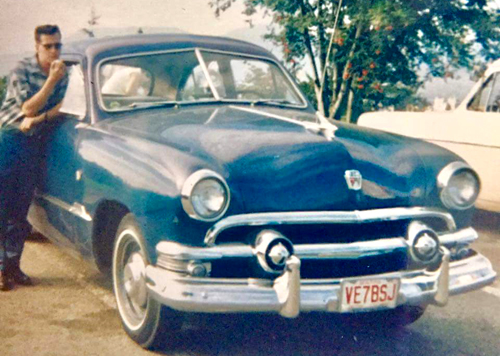 |
To mark the Centennial of Canadian Confederation in 1967, the province implemented a red-and-white colour scheme on its license plates, including the amateur radio plates. Shown at left is an example of the 67 ham plates, brought to us by VE7-BSJ. |
The ham radio license plates issued for 1968 are the only one's in this decade in which a dash appears in the middle of the plate. |
| 1968 |
|
|
|
|
Issuing
Statistics |
Initial Series:
|
Not applicable |
Registered:
|
Unknown |
Over-run:
|
|
Issued:
|
Pairs |
Manufacturer:
|
Oakalla Prison |
Dimensions:
|
302 mm x 150 mm |
Material:
|
Steel |
Comments: Plates were issued on an "as needed" basis when requested by licenced amateur radio operators. |
|
|
|
|
|
|
|
|
|
|
|
|
|
|
Whereas two-character call signs were generally centered in the middle of the plate in previous years, in 1969 this changed with the result that these call signs were generally centered to the left. There is a known example (VE7LL - see below) where the call sign has been centered in the middle, but it is not known how common this was. |
| 1969 |
|
|
|
|
Issuing
Statistics |
Initial Series:
|
Not applicable |
Registered:
|
Unknown |
Over-run:
|
|
Issued:
|
Pairs |
Manufacturer:
|
Oakalla Prison |
Dimensions:
|
302 mm x 150 mm |
Material:
|
Steel |
Comments: Plates were issued on an "as needed" basis when requested by licenced amateur radio operators. |
|
|
|
|
|
|
|
|
|
|
For the 1970 base, the dash between VE7 and the remaining characters in the call sign appeared for the last time. |
| 1970 - 1972 |
|
|
|
|
Issuing
Statistics |
Initial Series:
|
Not applicable |
Registered:
|
Unknown |
Over-run:
|
|
Issued:
|
Pairs |
Manufacturer:
|
Oakalla Prison |
Dimensions:
|
302 mm x 150 mm |
Material:
|
Steel |
Comments: Plates were issued on an "as needed" basis when requested by licenced amateur radio operators.Registration decals used on this base are the same as those issued for use on passenger vehicles for the years 1970-1972 .
|
|
|
|
|
|
|
|
|
|
|
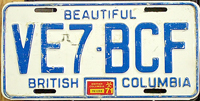
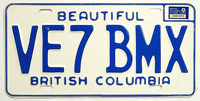
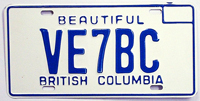
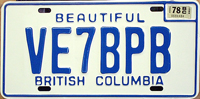
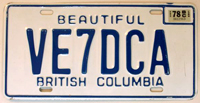
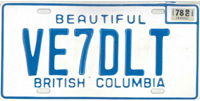
With the closure of the Plate Shop at Oakalla Prison in the mid-1970s, there are two types of dies that appear on ham radio plates made on the 1973 base. In the gallery below, the classic Oakalla dies can be seen in the top two rows. In the bottom two rows are plates displaying the "Quebec Dies" associated with ACME Signalisation, a Quebec company that manufactured a batch of plates for BC in this period. |
| 1973 - 1978: Oakalla Dies |
|
|
|
|
Issuing
Statistics |
Initial Series:
|
Not applicable |
Registered:
|
Unknown |
Over-run:
|
|
Issued:
|
Pairs |
Manufacturer:
|
Oakalla Prison |
Dimensions:
|
302 mm x 150 mm |
Material:
|
Steel |
Comments: Plates were issued on an "as needed" basis when requested by licenced amateur radio operators. Registration decals used on this base are the same as those issued for use on passenger vehicles for the years 1974-1978.
|
|
|
|
|
|
|
|
|
|
|
| 1977 - 1978: ACME Dies |
|
|
|
|
Issuing
Statistics |
Initial Series:
|
Not applicable |
Registered:
|
Unknown |
Over-run:
|
|
Issued:
|
Pairs |
Manufacturer:
|
ACME Signalisation |
Dimensions:
|
302 mm x 150 mm |
Material:
|
Aluminium |
Comments: Plates were issued on an "as needed" basis when requested by licenced amateur radio operators. Registration decals used on this base are the same as those issued for use on passenger vehicles for the years 1974-1978 .
|
|
|
|
|
|
|
|
|
|
|
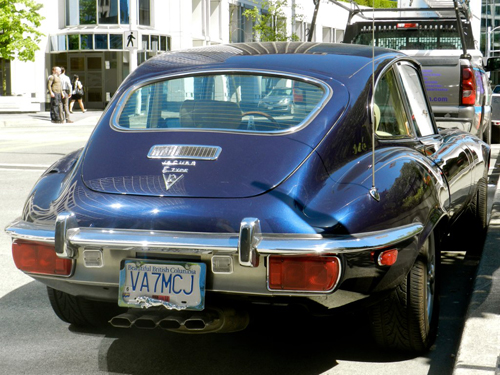 |
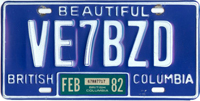
Once upon a time, there was an expectation that vehicles displaying an Amateur Radio plate would have radio equipment on-board for use in case of an emergency (and could usually be identified by the over-sized antennae's sticking out of the vehicle). Over time, this expectation changed and the plates came to be used more to identify the driver as someone experienced with using radio equipment (and the size of vehicles displaying Ham plates shrunk). |
| 1979
- 1986: "Blue" Base Plate |
|
|
|
|
Issuing
Statistics |
Initial Series:
|
Not applicable |
Registered:
|
Unknown |
Over-run:
|
|
Issued:
|
Pairs |
Manufacturer:
|
ACME Signalisation |
Dimensions:
|
300 mm x 150 mm |
Material:
|
Aluminium |
Comments: Plates were issued on an "as needed" basis when requested by licenced amateur radio operators. Registration decals used on this base are the same as those issued for use on passenger vehicles for the years 1981-1986 .
|
|
|
|
|
|
|
|
|
|
|
| 1986
- 2002: Flag Graphic / Astrographic Dies |
|
|
|
|
Issuing
Statistics |
Initial Series:
|
Not applicable |
Registered:
|
Unknown |
Over-run:
|
|
Issued:
|
Pairs |
Manufacturer:
|
Astrographics |
Dimensions:
|
300 mm x 150 mm |
Material:
|
Aluminium |
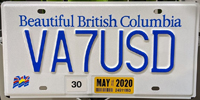
Comments: Plates were issued on an "as needed" basis when requested by licenced amateur radio operators. Registration decals used on this base are the same as those issued for use on passenger vehicles for the years 1986 to present. Introduction of "VA7" prefix occurred in 1999.
|
|
|
|
|
|
|
|
|
|
|
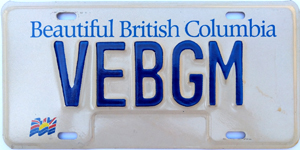
At right is a 1980s or 1990s error plate missing the 7 in the call sign: |
 |
 |
We aren't sure what message is attempting to be sent with this plate, but we think the vanity plate motifs were added to a standard Amateur Radio base. It has been a while since we have seen a "Jersey Foul" like this ... |
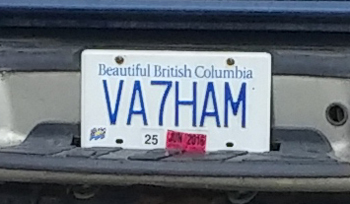 |
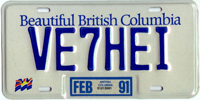
In 1999, B.C.’s three-letter prefix has been
expanded to include VA7. This was done in order to accommodate
the growing number of Ham Radio operators in the province
(who were also apparently complaining that all the good suffixes
were taken). If you would like to see a list of the remaining
call signs available in both the VE7 and VA7 format, just
following this link: http://www.rac.ca/acl/bc/all.html |
| 2002 - present: Flag Graphic / Waldale Dies |
|
|
|
|
Issuing
Statistics |
Initial Series:
|
Not applicable |
Registered:
|
Unknown |
Over-run:
|
|
Issued:
|
Pairs |
Manufacturer:
|
Waldale |
Dimensions:
|
300 mm x 150 mm |
Material:
|
Aluminium |
Comments: Plates were issued on an "as needed" basis when requested by licenced amateur radio operators. Registration decals used on this base are the same as those issued for use on passenger vehicles for the years 2002 to present.
|
|
|
|
|
|
|
|
|
|
|
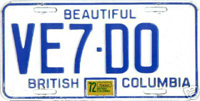
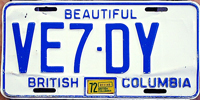
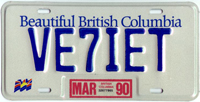
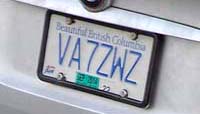
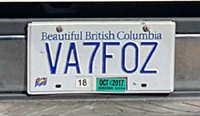
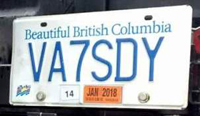
The
plates shown above are actually valid British Columbia
Ham plates despite displaying either a "VE7" or "VA7" prefix. In these cases, VE1 is a Maritime call sign
while VE3 is the call signs for Ontario. Despite the
ICBC web site proclaiming that "amateur radio
operators moving to B.C. from another province must
apply to Industry Canada for a B.C.-prefixed call
sign", it would appear that this has not always
been the case (or that the rule is loosely enforced). |
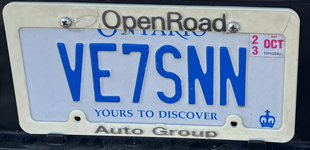
The issuance of a BC call sign on another jurisdictions license plate also happens on occasion, such as this plate in Ontario. |
| Dual Decal Well: 2014 |
|
Thanks to this submission from Bill Manners (VA7BMJ) we now know that the HAM base has been switched over to the dual decal as of October 2014 (and possibly sooner than this). |
| Spicy Ham! |
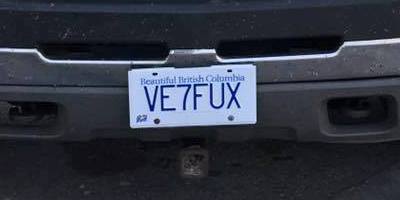
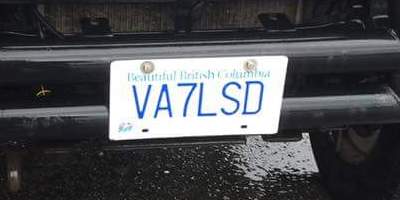
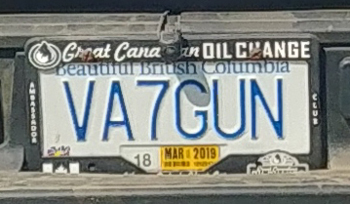
An interesting aspect of the Ham Radio plates is that Call Signs are assigned by the Federal Government (Industry Canada) and the feds do not appear to apply any filters to the combinations of letters that can be applied for. |
Conversely, ICBC is usually pretty-straight laced and puritanical when it comes to the slogans it will allow to be displayed on a license plate, but has effectively ceded this oversight to the Federal Government when it comes to Ham Radio plates with some very amusing and, dare we say, subversive results: |
We suspect that these are probably some of the only instances where ICBC will allow a license plate to promote fornication (top left), drug consumption (top right) and gun ownership (bottom). |

© Copyright Christopher John
Garrish. All rights reserved.
|
.jpg)
.jpg)

.jpg)
.jpg)
.jpg)

.jpg)

.jpg)
.jpg)
.jpg)
.jpg)
.jpg)
.jpg)
.jpg)
.jpg)
.jpg)
.jpg)
.jpg)
.jpg)
.jpg)
.jpg)
.jpg)
.jpg)
.jpg)
.jpg)
.jpg)
.jpg)
.jpg)
.jpg)
.jpg)
.jpg)
.jpg)
.jpg)
.jpg)
.jpg)
.jpg)
.jpg)
.jpg)
.jpg)
.jpg)
.jpg)
.jpg)
.jpg)
.jpg)
.jpg)
.jpg)
.jpg)
.jpg)
.jpg)
.jpg)
.jpg)
.jpg)
.jpg)
.jpg)
.jpg)
.jpg)
.jpg)
.jpg)
.jpg)
.jpg)
.jpg)
.jpg)
.jpg)
.jpg)
.jpg)
.jpg)
.jpg)
.jpg)
.jpg)
.jpg)
.jpg)
.jpg)
.jpg)
.jpg)
.jpg)
.jpg)
.jpg)
.jpg)
.jpg)
.jpg)
.jpg)
.jpg)
.jpg)
.jpg)
.jpg)
.jpg)
.jpg)
.jpg)
.jpg)
.jpg)
.jpg)
.jpg)
.jpg)
.jpg)
.jpg)
.jpg)
.jpg)
.jpg)
.jpg)
.jpg)
.jpg)
.jpg)
.jpg)
.jpg)
.jpg)

.jpg)